Showing posts with label Kasperivtsi. Show all posts

5 Things I Learned From Reading “Copernicus Avenue” by Andrew J. Borkowski

I grew up on the fringe of post World War Two Polish immigrant experience in Toronto. My family wasn’t Polish, they were Ukrainian. But my father grew up in Eastern Europe in Kasperivtsi, a village that was part of Malopolska, or ‘Little Poland’ between the two world wars. He was schooled in Polish and spoke it fluently. We had family friends who were Polish or ‘became Polish’ by marrying a Pole. 

copernicusave
So when my friend Mary E. McIntyre recommended the Giller Prize-nominated  book “Copernicus Avenue” to me, I read it with interest. Borkowski, in 16 linked short stories, gives us the urban Toronto Polish immigrant’s post-war experience along with the heartbreaking backstory of the Katyn and Baranica massacres. I learned five things reading the book.

  1. 1. I learned or re-learned the power of landscape and memory when telling a story. Borkowski creates a fictitious street in the heart of the old Roncesvalles neighbourhood in Toronto’s west end. It could have been any Polish neighbourhood in any city, but for me it brought back memories of visiting friends in Parkdale and Roncesvalles as a child. In fact, the house on the cover looks exactly like the house some Polish friends lived in on Macdonnell Avenue, the eastern boundary of the Roncesvalles neighbourhood. On Saturdays my Dad would sometimes take us down to visit these friends and also to buy fresh Kielbasa and Paska or Kolach for the holidays. I can still remember the smell of the garlic sausage mixed with the aroma of sawdust scattered on the floor of the butcher shop. Borkowski evokes this neighbourhood through sensual details about bakeries, butcher shops, churches and statues, street life and the characters that inhabited the neighbourhood. I felt like I was back there with my Dad.
  2. I learned that memoir can be fiction and fiction can be memoir. In other words, the writer can choose the stories to tell and how to tell them. Life-based stories can be presented as fiction when the writer feels he doesn’t remember enough to make it a memoir, but he can still base the stories on his life and memories. Which is better? Neither. It depends what the writer wishes to achieve and how well he remembers his life.
  3. I learned that linked stories together can be like a memoir or a novel. Grouped together with the same characters and time and place, these stories form a coherent whole. Each story can stand on its own and might even be published individually, as in Borkowski’s case with his story ‘Twelve Versions of Lech’. An emerging writer can increase his chances of finding a book publisher by having already published some stories.
  4. I learned or I was reminded that I never really understood  the Polish World War Two experience, though I'd met people who’d survived it. The problem was: no adult wanted to explain in detail to a curious child what had happened. Why was a Polish friend flying for the British Air Force? Shouldn’t he be in the Polish Air Force? Oh, wait a minute, Poland was invaded and disappeared from the map for  a while. This book reveals the hidden wounds and resulting behaviors of these immigrant characters, all of which seem terribly familiar to me. I learned about the horrors of Polish deportation to Siberia from Jane/Janina Boruszewski and I’m still learning subtle details of survival.
  5. I learned how historical details (backstory) can be woven into the story in description, character, plot and dialogue, without weighing down the flow of the story. Now to figure out how to do that myself!

Getting Published

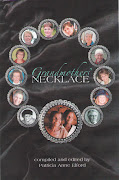
Yesterday I received a package containing a copy of Grandmothers’ Necklace where two of my poems appear: one about each of my grandmothers.

I tear the padded bag open and am unprepared for the thrill. OMG, as the kids say in text-speak; my chest fills with pride as I search for my entries. There’s one of them on the first page! Knowing You © Ruth Zaryski Jackson 2009. I exhale, read quickly through it and glance at the photo of my paternal grandmother, my Baba. Very nice, though the quality of the photo I sent was poor. Still, the first entry. Good start.

Next, I look for my other one. There it is on page 38 but whoops, my name is misspelled: Zarysky instead of Zaryski. Flash of anger. That was careless of somebody. The editor, the publisher; who to blame? Gradually I relax. I talk to myself. It’s ok, Ruth. It’s correct in the first entry. Maybe they can correct it in future print runs. Just chill.

I forget about the error and focus on the poem. Wash Day © Ruth Zaryski Jackson 2009. Looks fine, though not as prominent on the left side of the book. The old photos of my grandmother and my mother at age 6 are not bad. I read the poem and smile. Not too bad at all.

I’d arranged to meet a couple of old university friends in Toronto last night at the former Park Plaza Hotel Roof Top Lounge, so I tuck a copy of the book in my bag. When I show it to them, they’re impressed. I smile with pride. I’m a writer now and here’s proof.

By the time I roll into bed, after reading a few more pieces in the book, I yawn and expect to be out in a flash. No. The excitement is still bubbling. I enjoy the reruns of the day for several more hours.

Thoughts on My Father

On December 5th my father would have been 98 years of age. In his memory I am posting this personal essay.

Thoughts on My Father

by Ruth Zaryski Jackson


The Priest swings the censer in a wide cross over the coffin and discordant harmonies of the Ukrainian Orthodox service fill my ears. Musty incense wafts into my nostrils as six pallbearers carry Dad’s casket out the chapel’s side door to the hearse which will take his body to the crematorium. I weep as I follow. I weep for my father who has left us finally and forever. I weep for the father I had and for the father I missed having.

On the 21st of January, 2000, during the first sub-zero blizzard of the season, my father died. He’d reached the millennium, but his heart stopped three weeks later. He was 88.


We moved Dad to a nursing home only five months earlier when Mom could no longer cope. She nursed him at home for years as his mind became more and more tangled. Was it Alzheimer’s or toxic metal exposure during a long welding career?


In the end his lungs failed him. A smoker from the age of 10, he’d given it up reluctantly in his 70s when diagnosed with a black spot on his right lung. Years later he forgot he’d stopped, started up again briefly, before forgetting again. The damage was done.


Major surgery prevented me from visiting for two months after Dad moved. I saw him only twice before a flu epidemic closed the nursing home to visitors. Before I could return with his Christmas pyjamas, he died.

Our life-long relationship had been distant. We didn’t clash openly, but rarely engaged. I learned early to get on with my life. I was a baby when he left for 18 months to work on construction of the Alaska Highway. He visited just once during that period when I was 14 months. The family story is: as he was leaving again, I held onto him tightly at Union Station, crying and wouldn’t let go. When he returned he found my personality at 2 ½, defined by my mother and the residents of our rooming house.

Born in Galicia (now Ukraine) in 1911, Dad spoke Ukrainian at home, Polish at school and later learned English. His own father had been absent for 7 years during WW1 then the Civil War which followed, and returned when Dad was 10. As his father attempted to discipline and make a man of him, Dad rebelled, and at 16, emigrated alone to Canada. He never looked back, except once, when he cried upon hearing in 1947, his beloved younger brother never returned from the war.


Dad reported growing up in a “reasonably happy” family with 5 siblings. In 1914 WWI broke out, eventually disrupting his schooling and casting a pall over village life. They dodged flying bullets, billeted soldiers, and hid in cellars. He played war games with friends during the quiet times. In the fabric of his early life, fear dwelt below the surface. The tumultuous history of Galicia made Dad a political animal and, given other educational opportunities, he might have become a lawyer or a politician.

Few early photos of my father survive. On his passport, he appears younger than 16, a prominent widow’s peak above hooded eyes and full lips. He looks determined with youthful bravado. In another, he sits on a dock with arms crossed displaying wiry strength, wearing his bathing suit, black socks and dress shoes. In my earliest memory his hair had already thinned. He remained trim and muscular throughout his life, dressed well when he wasn’t working in coveralls and prided himself on tasteful suits and Daks shoes. He wore a Humphrey Bogart-style fedora during the 1940s and 1950s.

“Eric,” he told my son when he turned 16 “I going take you to buy good suit for very good price”.

And he did.

Dad was fiercely proud of his family, but unsure in his role as father. After several missteps, Dad grasped his role as husband, but needed Mom’s guidance to negotiate the nuances of living. He understood “bringing home the bacon” but left child-rearing to Mom.


“Wait till your father gets home!” she’d warn us when she reached her wit’s end.


I resented Dad’s willingness to strap us on her word alone. In my youngest brother Dad found a mirror image of himself and quickly judged and disowned his son. Despite Mom’s attempts to mediate, Dad stubbornly held fast to his disappointment.


As a friend, his loyalty to those from his village exceeded all expectation. A dying friend moved into their living room and my parents cared for him. My father, as Executor, carefully carried out the man’s wishes, dealing with a resentful wife and daughter abandoned in Ukraine. With his white-collar neighbours, he offered manual skills and connections to the trades. With his grandchildren, he was affectionate and playful, the way we’d wished he’d been as a father.


As I listen to the eulogies, I try to reconcile others’ perceptions with the man I knew. He seems loved by many, but as a child, I often wondered if he loved me. He never expressed it until one day I pressed him, fearing he might not survive an ulcer operation.


He held Old Country prejudices yet in his neighborhood he got along with everyone. Religion was a touchy subject. Raised Greek Catholic, where church formed the basis of village life, he resented Poland’s attempts to convert them to Roman Catholicism. He had a love-hate relationship with Poles, yet some of his friends were Polish. I never knew him to attend church except on rare holidays yet, as death approached, he announced he wanted the full Ukrainian Orthodox funeral service: cantors, incense and all.


When I reflect on my father today, I wonder what of him I carry inside? Physically, I resemble my mother. Inside, I hold some of his tendencies: loyalty to friends and family, responsibility and stubbornness. We also share similar opposite traits: sociable and introverted, nervous yet confident. Perhaps I am my father’s daughter after all.


1984 age 73