Here is a post by Jerry Waxler that poses the question about writing your parents' memoir? I wonder if this is a necessary step to writing our own?
Is this the year to write your parent’s memoir?
Copyright © 2012, Ruth Zaryski Jackson
Showing posts with label memoir. Show all posts
Showing posts with label memoir. Show all posts


Your Memories, Your Book: To Tell the Truth
A useful article on truth telling in memoir from Personal Historian Wayne Groner:
Your Memories, Your Book: To Tell the Truth: The Plain Truth This article is a variation of my guest post on Sharon Lippincott’s blog, The Heart and Craft of Life Writing . A commo...
Copyright © 2011, Ruth Zaryski Jackson
Your Memories, Your Book: To Tell the Truth: The Plain Truth This article is a variation of my guest post on Sharon Lippincott’s blog, The Heart and Craft of Life Writing . A commo...
Copyright © 2011, Ruth Zaryski Jackson
My Interview in ArtScene
A few months ago I was asked by The PineRidge Arts Council to do an interview for the September-October issue of their publication ArtScene. I was excited to receive my copy today.
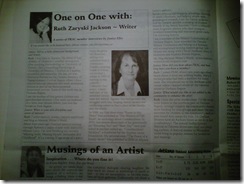
Since there is no online link and my BlackBerry photo is hard to read, I am publishing the interview here.
1. Tell us a little about your background and family.
I was born in Toronto, the eldest of four children of Ukrainian Canadian immigrants. After studying Anthropology at University of Toronto, then Counselling Psychology at University of Waterloo, I worked as a teacher, counsellor, and researcher. My last job was Historical Planner for the Ontario Ministry of Transportation’s Central Region where I documented heritage resources and made recommendations as part of the Environmental Assessment process. Some of this work was in Durham Region.
I am the mother of four grown children and grandmother of seven. I live with my husband on a farm near Mount Albert, just over the border in York Region.
2. What is your arts discipline and areas of interest?
I write memoir, poetry, creative nonfiction and blog at Memoir Writer’s World.
About four years ago, I started memoir writing through Ryerson University’s online course with instructor Allyson Latta. I’m now finishing my memoir “Missing Sadie, Missing Myself: Memories of a Childhood”.
It’s a coming of age story of a precocious daughter of Ukrainian immigrants uprooted from a downtown Toronto rooming house to follow her mother’s dream in 1950 of moving to the suburbs. Colourful characters, considered part of her extended family, were left behind. Against this background, she struggles with loss, longing, family secrets and conflicting values to find a place in her family and the world.
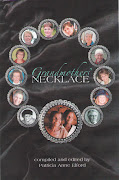
In 2008, my first short story “Room in My Heart” was published in "The Wisdom of Old Souls", an anthology about Grandmothers. In 2010, two poems about each of my grandmothers “Knowing You” and “Wash Day” were published in another anthology, "Grandmothers' Necklace", a fundraiser for the Stephen Lewis Foundation. My personal essay “The Power of a Family Secret” was published in 2010 on Allyson Latta’s website.
Besides writing and blogging, genealogy, learning to speak Ukrainian, and helping people with genealogical research, I am the family archivist and my present passion is picking up dropped threads in my family histories. I love to research some forgotten relative who died young or invented something and was never given credit. I’m rewriting history.
I am a member of the Writers’ Community of Durham Region, have attended the Ontario Writers’ Conference and belong to a dynamic and accomplished writing support group: Life Writers Ink along with Cheryl Andrews, Mary E. McIntyre and Anahita Printer Nepton.
My blog Memoir Writer’s World address: http://www.memoirwritersworld.blogspot.com/
3. How did you hear about PRAC and how long have you been a member?
I joined P.R.A.C. about two years ago when I heard about it from my writing buddy, Mary E. McIntyre who had been a member for many years. She introduced me to the Arts Scene newsletter where I learned about all the talented artists in Durham Region.
4. What would you like to see added to the community to enhance the arts?
I love the artist studio tours. I’d like to see more events in the northern part of Durham Region, stronger support for community theatre, more funding for Arts groups and more free arts activities for children in the community such as year round Arts camps for kids. Do Durham libraries have an Authors Series as we do in East Gwillimbury? The annual Stellar Literary Festival in Oshawa showcases local and emerging authors. A festival similar to WordsAlive could bring in popular writers for workshops and readings.
Post Script: The inaugural McLaughlin Literary Festival will be taking place at the Parkwood Estate in Oshawa on Sunday September 18, 2011.

Since there is no online link and my BlackBerry photo is hard to read, I am publishing the interview here.
1. Tell us a little about your background and family.
I was born in Toronto, the eldest of four children of Ukrainian Canadian immigrants. After studying Anthropology at University of Toronto, then Counselling Psychology at University of Waterloo, I worked as a teacher, counsellor, and researcher. My last job was Historical Planner for the Ontario Ministry of Transportation’s Central Region where I documented heritage resources and made recommendations as part of the Environmental Assessment process. Some of this work was in Durham Region.
I am the mother of four grown children and grandmother of seven. I live with my husband on a farm near Mount Albert, just over the border in York Region.
2. What is your arts discipline and areas of interest?
I write memoir, poetry, creative nonfiction and blog at Memoir Writer’s World.
About four years ago, I started memoir writing through Ryerson University’s online course with instructor Allyson Latta. I’m now finishing my memoir “Missing Sadie, Missing Myself: Memories of a Childhood”.
It’s a coming of age story of a precocious daughter of Ukrainian immigrants uprooted from a downtown Toronto rooming house to follow her mother’s dream in 1950 of moving to the suburbs. Colourful characters, considered part of her extended family, were left behind. Against this background, she struggles with loss, longing, family secrets and conflicting values to find a place in her family and the world.
In 2008, my first short story “Room in My Heart” was published in "The Wisdom of Old Souls", an anthology about Grandmothers. In 2010, two poems about each of my grandmothers “Knowing You” and “Wash Day” were published in another anthology, "Grandmothers' Necklace", a fundraiser for the Stephen Lewis Foundation. My personal essay “The Power of a Family Secret” was published in 2010 on Allyson Latta’s website.
Besides writing and blogging, genealogy, learning to speak Ukrainian, and helping people with genealogical research, I am the family archivist and my present passion is picking up dropped threads in my family histories. I love to research some forgotten relative who died young or invented something and was never given credit. I’m rewriting history.
I am a member of the Writers’ Community of Durham Region, have attended the Ontario Writers’ Conference and belong to a dynamic and accomplished writing support group: Life Writers Ink along with Cheryl Andrews, Mary E. McIntyre and Anahita Printer Nepton.
My blog Memoir Writer’s World address: http://www.memoirwritersworld.blogspot.com/
3. How did you hear about PRAC and how long have you been a member?
I joined P.R.A.C. about two years ago when I heard about it from my writing buddy, Mary E. McIntyre who had been a member for many years. She introduced me to the Arts Scene newsletter where I learned about all the talented artists in Durham Region.
4. What would you like to see added to the community to enhance the arts?
I love the artist studio tours. I’d like to see more events in the northern part of Durham Region, stronger support for community theatre, more funding for Arts groups and more free arts activities for children in the community such as year round Arts camps for kids. Do Durham libraries have an Authors Series as we do in East Gwillimbury? The annual Stellar Literary Festival in Oshawa showcases local and emerging authors. A festival similar to WordsAlive could bring in popular writers for workshops and readings.
Post Script: The inaugural McLaughlin Literary Festival will be taking place at the Parkwood Estate in Oshawa on Sunday September 18, 2011.
5 Things I Learned From Reading “Copernicus Avenue” by Andrew J. Borkowski
I grew up on the fringe of post World War Two Polish immigrant experience in Toronto. My family wasn’t Polish, they were Ukrainian. But my father grew up in Eastern Europe in Kasperivtsi, a village that was part of Malopolska, or ‘Little Poland’ between the two world wars. He was schooled in Polish and spoke it fluently. We had family friends who were Polish or ‘became Polish’ by marrying a Pole.

So when my friend Mary E. McIntyre recommended the Giller Prize-nominated book “Copernicus Avenue” to me, I read it with interest. Borkowski, in 16 linked short stories, gives us the urban Toronto Polish immigrant’s post-war experience along with the heartbreaking backstory of the Katyn and Baranica massacres. I learned five things reading the book.

So when my friend Mary E. McIntyre recommended the Giller Prize-nominated book “Copernicus Avenue” to me, I read it with interest. Borkowski, in 16 linked short stories, gives us the urban Toronto Polish immigrant’s post-war experience along with the heartbreaking backstory of the Katyn and Baranica massacres. I learned five things reading the book.
- 1. I learned or re-learned the power of landscape and memory when telling a story. Borkowski creates a fictitious street in the heart of the old Roncesvalles neighbourhood in Toronto’s west end. It could have been any Polish neighbourhood in any city, but for me it brought back memories of visiting friends in Parkdale and Roncesvalles as a child. In fact, the house on the cover looks exactly like the house some Polish friends lived in on Macdonnell Avenue, the eastern boundary of the Roncesvalles neighbourhood. On Saturdays my Dad would sometimes take us down to visit these friends and also to buy fresh Kielbasa and Paska or Kolach for the holidays. I can still remember the smell of the garlic sausage mixed with the aroma of sawdust scattered on the floor of the butcher shop. Borkowski evokes this neighbourhood through sensual details about bakeries, butcher shops, churches and statues, street life and the characters that inhabited the neighbourhood. I felt like I was back there with my Dad.
- I learned that memoir can be fiction and fiction can be memoir. In other words, the writer can choose the stories to tell and how to tell them. Life-based stories can be presented as fiction when the writer feels he doesn’t remember enough to make it a memoir, but he can still base the stories on his life and memories. Which is better? Neither. It depends what the writer wishes to achieve and how well he remembers his life.
- I learned that linked stories together can be like a memoir or a novel. Grouped together with the same characters and time and place, these stories form a coherent whole. Each story can stand on its own and might even be published individually, as in Borkowski’s case with his story ‘Twelve Versions of Lech’. An emerging writer can increase his chances of finding a book publisher by having already published some stories.
- I learned or I was reminded that I never really understood the Polish World War Two experience, though I'd met people who’d survived it. The problem was: no adult wanted to explain in detail to a curious child what had happened. Why was a Polish friend flying for the British Air Force? Shouldn’t he be in the Polish Air Force? Oh, wait a minute, Poland was invaded and disappeared from the map for a while. This book reveals the hidden wounds and resulting behaviors of these immigrant characters, all of which seem terribly familiar to me. I learned about the horrors of Polish deportation to Siberia from Jane/Janina Boruszewski and I’m still learning subtle details of survival.
- I learned how historical details (backstory) can be woven into the story in description, character, plot and dialogue, without weighing down the flow of the story. Now to figure out how to do that myself!
E-book Sales, Romance and Memoir Publishing
About a year ago Sandy Naiman, a journalist friend I hadn't seen for many years, asked me if my book would be coming out in print or E-book format. No one had ever asked me that question. I was taken aback and replied: "Oh, print, of course." Now I'm reconsidering my answer.
This week the stats came out on E-Book sales: up 172% in August and almost 193% for the year. I sat up and took more than passing notice because a couple of other things happened this week to make me stop and think about E-Books.
E-book Sales Jump 172% in August
At this month's WCDR breakfast meeting this month I met a writer who has 4 different E-Book publishers for her novels and is making a passable living from royalties after only one year. She specializes in romance, fantasy novels; there is a big market and many publishers for this genre.
The advantages for the publisher are obvious: lower costs, less risk. But the advantage for the emerging writer are that a publisher may willing to take a risk on you and the royalties may be greater than in print books.
.jpg) Another wake-up call was the news that my cousin Mary self-published her memoir in Naples, Florida and though she has printed copies for family members, has also posted E-Book versions on a wesite for others to read. Congratulations, Mary! This is an admirable achievement and will be appreciated by many. I have posted a link to the left of this post.
Another wake-up call was the news that my cousin Mary self-published her memoir in Naples, Florida and though she has printed copies for family members, has also posted E-Book versions on a wesite for others to read. Congratulations, Mary! This is an admirable achievement and will be appreciated by many. I have posted a link to the left of this post.
Now I will investigate the possibility of an E-Book publisher for my memoir. Are you considering an E-Book for yours?
Copyright © 2010, Ruth Zaryski Jackson
This week the stats came out on E-Book sales: up 172% in August and almost 193% for the year. I sat up and took more than passing notice because a couple of other things happened this week to make me stop and think about E-Books.
E-book Sales Jump 172% in August
At this month's WCDR breakfast meeting this month I met a writer who has 4 different E-Book publishers for her novels and is making a passable living from royalties after only one year. She specializes in romance, fantasy novels; there is a big market and many publishers for this genre.
The advantages for the publisher are obvious: lower costs, less risk. But the advantage for the emerging writer are that a publisher may willing to take a risk on you and the royalties may be greater than in print books.
.jpg)
Now I will investigate the possibility of an E-Book publisher for my memoir. Are you considering an E-Book for yours?
Copyright © 2010, Ruth Zaryski Jackson
The Power of a Family Secret
My personal essay The Power of A Family Secret has now been posted on Allyson Latta's new website. This essay appeared in an earlier version in several blog posts on this site. Please click on the title of my essay or Allyson's name, have a look and let me know what you think.
Copyright © 2010, Ruth Zaryski Jackson
Copyright © 2010, Ruth Zaryski Jackson
Letter to My Dead Great-Aunt Part Three
My mother told me Uncle John didn’t like to spend money but as your next of kin, he would have been the one responsible for your burial. I wondered if he had done nothing to commemorate your life. Maybe your body was never recovered. Maybe he was too overcome with grief. I wished I had asked Auntie Huckan, his wife but I hadn’t known about you then. I wished my mother had asked her but she didn’t think to ask. I found the details of your burial by chance and more details on your Death Certificate.
Armed with the name of the hotel where you died and the exact date of the fire, I pressed on and tried to find a photograph of the building. The Riverview Hotel had been built in 1906 or earlier (Henderson Directory 1906) and a large 1-storey addition of wood construction had been added in 1914. The Winnipeg architect, Charles S. Bridgeman designed it for the owner, J.J. O'Connell in 1913. No photograph was found but an interesting discovery showed up in the city records.
Negligence
I discovered on the Building Permit for the addition, the owner J.J. O'Connell had on June 11, 1914 been “convicted and reprimanded for not complying with Notice issued January 7, 1914 re Exit doors”. A Building Inspector had deemed the building dangerous four years before the fire! Maybe even before you were hired.
The Historical Buildings Officer for Winnipeg sent me several newspaper clippings about the fire on the night of February 5, 1918 when the Riverview Hotel burned to the ground. Three perished in the fire: a nurse employed by the owner, a veteran of WWI and you, my dear Great-Aunt Michalena, described as “Lena Wuchan, kitchen girl” and “Lena Guchan, kitchen maid”. They couldn’t even spell your name right.
Here’s what happened as I can piece it together from the clippings. Early in the morning on the 5th of February about 3:30 a.m. a fire broke out, possibly in the kitchen of the Riverview Hotel. Fanned by 30 mile an hour gale force winds, the fire quickly spread to nearby buildings. Five fire brigades responded promptly though there were 6-8 other fires in Winnipeg at that night. The Riverview Hotel was leveled within an hour. Total damage was estimated to be $180,000.
A neighbor called the fire department. Everyone was asleep when the alarm bells in each room went off. You were last seen in your room on the second floor. Smoke poured into the rooms and the stairs were blocked by dense smoke. The hotel owner, his wife and six children were sleeping on the first floor and all escaped unharmed except for smoke inhalation. Mr. O’Connell later told the press of the frantic attempts to escape by those who died. I can only try to imagine the terror you felt when you realized there was no way out.
Your body was found in the ashes two days later near the centre of the basement buried several feet beneath the debris. They believed these were your remains because they were found in the location of your room in the building. But you were found in the basement, because all three stories collapsed. Identification of the three victims was based on location of the bodies when found. A fourth victim died later in hospital.
The inquest a week later found no fault lay on the shoulders of the hotel owner or the fire department for the deaths, despite the fact that the building hadn’t been inspected for a year.

And so dear Auntie, this is your story, the evidence that you lived and died in Winnipeg in a tragic hotel fire that cold February night in 1918. There are still some gaps and incomplete knowledge of your short life. I promise you I will continue to search for more details, such as your immigration records and whatever vital records exist in Winnipeg or your ancestral village of Repuzhintsy. My cousins and I will be replacing the numbered stone on your grave with a personal memorial stone. I will honour your life by telling your story to all who will listen. I will never forget you and other immigrants who lost their lives in accidents and unsafe working conditions, trying to build a better life and a brighter future in Canada.
May your soul rest in peace. Vichnaya Pamiat.
love from your Grandniece,
Ruth
Copyright © 2010, Ruth Zaryski Jackson
Armed with the name of the hotel where you died and the exact date of the fire, I pressed on and tried to find a photograph of the building. The Riverview Hotel had been built in 1906 or earlier (Henderson Directory 1906) and a large 1-storey addition of wood construction had been added in 1914. The Winnipeg architect, Charles S. Bridgeman designed it for the owner, J.J. O'Connell in 1913. No photograph was found but an interesting discovery showed up in the city records.
Negligence
I discovered on the Building Permit for the addition, the owner J.J. O'Connell had on June 11, 1914 been “convicted and reprimanded for not complying with Notice issued January 7, 1914 re Exit doors”. A Building Inspector had deemed the building dangerous four years before the fire! Maybe even before you were hired.
The Historical Buildings Officer for Winnipeg sent me several newspaper clippings about the fire on the night of February 5, 1918 when the Riverview Hotel burned to the ground. Three perished in the fire: a nurse employed by the owner, a veteran of WWI and you, my dear Great-Aunt Michalena, described as “Lena Wuchan, kitchen girl” and “Lena Guchan, kitchen maid”. They couldn’t even spell your name right.
 |
| Riverview Hotel 322 Nairn Avenue Elmwood, Manitoba |
A neighbor called the fire department. Everyone was asleep when the alarm bells in each room went off. You were last seen in your room on the second floor. Smoke poured into the rooms and the stairs were blocked by dense smoke. The hotel owner, his wife and six children were sleeping on the first floor and all escaped unharmed except for smoke inhalation. Mr. O’Connell later told the press of the frantic attempts to escape by those who died. I can only try to imagine the terror you felt when you realized there was no way out.
Your body was found in the ashes two days later near the centre of the basement buried several feet beneath the debris. They believed these were your remains because they were found in the location of your room in the building. But you were found in the basement, because all three stories collapsed. Identification of the three victims was based on location of the bodies when found. A fourth victim died later in hospital.
The inquest a week later found no fault lay on the shoulders of the hotel owner or the fire department for the deaths, despite the fact that the building hadn’t been inspected for a year.
 |
| Newspaper Clippings from Winnipeg Firefighters Museum 1918 |

And so dear Auntie, this is your story, the evidence that you lived and died in Winnipeg in a tragic hotel fire that cold February night in 1918. There are still some gaps and incomplete knowledge of your short life. I promise you I will continue to search for more details, such as your immigration records and whatever vital records exist in Winnipeg or your ancestral village of Repuzhintsy. My cousins and I will be replacing the numbered stone on your grave with a personal memorial stone. I will honour your life by telling your story to all who will listen. I will never forget you and other immigrants who lost their lives in accidents and unsafe working conditions, trying to build a better life and a brighter future in Canada.
May your soul rest in peace. Vichnaya Pamiat.
love from your Grandniece,
Ruth
Copyright © 2010, Ruth Zaryski Jackson
Letter to My Dead Great-Aunt Part Two
The family story I heard from Mother and her sister Anne is that you were working at a hotel in Winnipeg saving your money to be married to your unnamed fiancé in the photograph. When fire broke out, you escaped somehow but ran back in to retrieve your $800 hidden under your mattress. You never came out. Were you overcome by smoke in that firetrap? Did the fire spread much faster than you anticipated? Or were you just a naïve girl who didn’t understand the danger and could only think of your hard-earned savings and your future going up in smoke? Eight hundred dollars in today’s dollars would be a lot of money. Brave or foolish, you lost your life in that fire.
I searched for a long time for your death and burial records. I searched newspapers for reports of a hotel fire but there were many hotel fires in Winnipeg in those days especially in the long cold winters. Photos are legend.
My cousin Ellen and I searched through countless cemetery lists until one day I found an on-line listing of Winnipeg City cemeteries and was able to find a listing for a “Lena Huekow” who died 2/5/1918. Confident this must be you, I contacted the City of Winnipeg who told me that they had no record of a “Michalena Huckan” but did have a “Lena Huckow” buried in Brookside Cemetery. My cousin Edith later confirmed that at last we had found your final resting place right next to the casualties of WW I. Further research revealed the name of the hotel, Riverview, (on the Red River) and the address, 322 Nairn Avenue in Elmwood. Finally I was able to obtain your Death Certificate. I requested the Coroner’s report but the records had been destroyed.
What would it have meant to me if you had lived, Michalena? You might have been like a Baba to me. I never knew my Baba, your sister. She died when I was 2 ½ . I saw her only once when I was 1 ½ and have no memory of the visit or her. You were 13 years younger so I might have known you. Maybe you would have moved to Oshawa where your older brother John lived for many years. He also died before I was born but his wife lived for many years. I knew her well and in fact was named, Frances, after her.
The only photos I have of Baba are taken when she was older, aged and toothless before her time. When I look at photos of my grandmother, your older sister Marya and you, Michalena, I see what she must have looked like as a young girl. I think she must have been as pretty as you when she was a young woman. I feel closer to her somehow. Closer to her youth.
To be continued...
Copyright © 2010, Ruth Zaryski Jackson
I searched for a long time for your death and burial records. I searched newspapers for reports of a hotel fire but there were many hotel fires in Winnipeg in those days especially in the long cold winters. Photos are legend.
 |
| Scott Bathgate - February 15, 1917 K. Elder Collection The Firefighters Museum of Winnipeg |
What would it have meant to me if you had lived, Michalena? You might have been like a Baba to me. I never knew my Baba, your sister. She died when I was 2 ½ . I saw her only once when I was 1 ½ and have no memory of the visit or her. You were 13 years younger so I might have known you. Maybe you would have moved to Oshawa where your older brother John lived for many years. He also died before I was born but his wife lived for many years. I knew her well and in fact was named, Frances, after her.
 |
| John Huckan and Frances Ross Huckan Winnipeg, Manitoba c. 1914 |
The only photos I have of Baba are taken when she was older, aged and toothless before her time. When I look at photos of my grandmother, your older sister Marya and you, Michalena, I see what she must have looked like as a young girl. I think she must have been as pretty as you when she was a young woman. I feel closer to her somehow. Closer to her youth.
 |
| Marya Huckan Zarecka Sclater, Manitoba c.1940 |
Copyright © 2010, Ruth Zaryski Jackson
In Honour of Father's Day: A Story About My Dad
 Dad Cooks
“Jimmy, come quick, Dad’s cooking!”
“Dad’s cooking?” My brother knew something was up. Mom always did the cooking at our house.
“Yeah, come on, let’s watch him. He’s making french fries!”
We dashed into the house and sank down on the vinyl chairs around the arborite table. Dad stood in the middle of the kitchen, a tea towel tucked around his pants, like a chef. Holding a few potatoes in one hand, a paring knife in the other, he dropped them into the enamel sink and ran the cold water. After peeling them, he moved to a cutting board on the table and stood over the pile. Without saying a word, he began to slice the potatoes into layers and sliver them into long squared pieces, carefully dropping them into cold water as he worked. His rough fingers, plump like sausages, were more used to manual labour than food preparation. In the days before frozen supermarket fries, he amazed us by replicating what we’d only seen in restaurants.
In fact, Dad had worked as a short-order cook. In the 1930s, after riding the rails to New Brunswick and back to Manitoba, a sawmill foreman told him to “get a trade”, to make something of himself. When he first arrived in Toronto, he waitered occasionally at the Savarin Hotel while taking welding courses at night. One night, the owner of Hunt’s Restaurant offered him a training course and steady job at $7.00 a week. Dad accepted because welding jobs were still scarce. He worked for Hunt’s for 5 years, moving from a kitchen on Mount Pleasant Road, to another at St. Clair and Oakwood, and finally, to College and Dovercourt, increasing his pay by $1.00 a week with each move and advancing to manager. In those days, you could get Today’s Special, a complete meal, for 35 cents! In 1939, when wartime created industrial jobs, Dad moved on to welding and never looked back. Except for these odd moments of culinary inspiration.
Sometimes when preparing french fries Dad used the sunken burner and deep pot in the back left corner of the electric range. This time, he bent over the pot cupboard, pulled the deep-fryer from the back and poured in the oil. After bringing it to a boil, he carefully lowered the basket of raw potatoes into the yellow bubbles, his eyes fixed on the pot. Sometimes he would par-boil them and set the potatoes aside to be finished off to a golden brown at the last moment before eating. All four of us sat entranced with the entire process, nostrils filled with the heady smell of frying oil, our mouths open and watering, impatient to taste his masterpiece.
Mom remained in the background while Dad cooked, only emerging at the end to hand us the malt vinegar, salt and ketchup and slip in a vegetable and a few slices of meat to complete the meal.
Copyright © 2010, Ruth Zaryski Jackson
The Road: To Milo
I struggled with the idea of writing something to read at Milo’s funeral. I had never been able to speak at a funeral, even my father’s. I always feared tears would overwhelm me and erase anything I might be trying to say. My husband’s urgings just served to make me more anxious. “I can’t write under pressure! I’m not a Hallmark writer. I work to an inner rhythm”.
I wanted to write something for her, for my step-daughter, my daughter, whom I came to love and admire after over 40 years. The step-daughter who was 5 years older than my first child and forced me to parent her before I was ready. When she hit puberty and needed guidance, I was still dealing with my son’s childhood issues, baseball, summer camp, and public school. Scrambling, I did buy her first bra, bought books explaining the ‘facts of life’ and tried to offer what help I could since she lived with her mother in Toronto and only spent alternate weekends and some holidays with us.
Over the five days in Edmonton I worked on a poem using random notes I had written on the plane. I didn’t know where I was going with it but I knew I wanted it to be a tribute to her strengths. By the night before the funeral, I wasn’t happy with the ending and felt unsure about reading it. Then I realized that was symbolic for all that had happened. I wasn’t happy with her life ending prematurely either. So I read it as is. Perhaps I will tweak it further. Perhaps not.
 To Milo
Milo, named for an actress you never knew,
You trekked your bumpy way
Into our lives, our hearts.
Resilient, smiling, resolute,
You navigated two worlds,
Careful never to misstep
The line between country and city.
From school to school, then college.
On to parenthood before we knew it.
Dark years left behind
Out shadowed by baby light,
Travel, another child,
The petite daughter to complete your family,
Submerged in happy domesticity.
More years of turmoil:
You made choices to survive,
Protect your chicks,
Rise above sorrow, grief,
Your mother’s passing.
Seven years in South Dakota brightened life,
College beckoned.
Happiness broke through in snatches.
Back to Alberta, familiar ground
Where you lost and found love.
All the while a mother,
The finest of mothers.
We grieve now with your children,
Almost grown.
Raised and ready
To catch that cold north wind,
Change it into honeyed breezes.
With thoughts of you:
Whispering, directing,
Guiding, giggling,
Quizzing, questioning,
Always loving.
We grieve with the love that appeared,
The one who slipped in,
Grabbed you unawares,
Not knowing you had so little time.
We grieve as parents,
Our daughter lost,
Not meant to outlive our children.
Copyright © 2010, Ruth Zaryski Jackson
I wanted to write something for her, for my step-daughter, my daughter, whom I came to love and admire after over 40 years. The step-daughter who was 5 years older than my first child and forced me to parent her before I was ready. When she hit puberty and needed guidance, I was still dealing with my son’s childhood issues, baseball, summer camp, and public school. Scrambling, I did buy her first bra, bought books explaining the ‘facts of life’ and tried to offer what help I could since she lived with her mother in Toronto and only spent alternate weekends and some holidays with us.
Over the five days in Edmonton I worked on a poem using random notes I had written on the plane. I didn’t know where I was going with it but I knew I wanted it to be a tribute to her strengths. By the night before the funeral, I wasn’t happy with the ending and felt unsure about reading it. Then I realized that was symbolic for all that had happened. I wasn’t happy with her life ending prematurely either. So I read it as is. Perhaps I will tweak it further. Perhaps not.

Milo, named for an actress you never knew,
You trekked your bumpy way
Into our lives, our hearts.
Resilient, smiling, resolute,
You navigated two worlds,
Careful never to misstep
The line between country and city.
From school to school, then college.
On to parenthood before we knew it.
Dark years left behind
Out shadowed by baby light,
Travel, another child,
The petite daughter to complete your family,
Submerged in happy domesticity.
More years of turmoil:
You made choices to survive,
Protect your chicks,
Rise above sorrow, grief,
Your mother’s passing.
Seven years in South Dakota brightened life,
College beckoned.
Happiness broke through in snatches.
Back to Alberta, familiar ground
Where you lost and found love.
All the while a mother,
The finest of mothers.
We grieve now with your children,
Almost grown.
Raised and ready
To catch that cold north wind,
Change it into honeyed breezes.
With thoughts of you:
Whispering, directing,
Guiding, giggling,
Quizzing, questioning,
Always loving.
We grieve with the love that appeared,
The one who slipped in,
Grabbed you unawares,
Not knowing you had so little time.
We grieve as parents,
Our daughter lost,
Not meant to outlive our children.
Copyright © 2010, Ruth Zaryski Jackson
Losing a Daughter

Losing a daughter is like losing a piece of yourself, a part of your heart or your soul. This is true even when she was your step-daughter.
During the past weeks our family has been rocked by the sudden death of our daughter, Milo Jackson, at the age of 43. She had not been ill but suffered a fatal pulmonary embollism in her sleep on May 6, 2010. She was there in the evening and gone by morning. Twenty days later it seems like a bad dream. I still hope to wake up and find it was a mistake. It didn't really happen. But it did.
I met Milo when she was two years old, a smiling happy toddler. She spent every other weekend with us and holidays too. She was an active part of our family activities, rituals and celebrations. In this favourite photograph of her at about age four or five, she's holding her rabbit which we kept at the farm, and sitting at the piano. She loved playing the piano with Nonie, my husband's mother, whenever we were together.
While I was in Edmonton for the funeral I wrote a poem for Milo which I read during the service. I will be publishing it here as I write about this experience over the next few weeks. Thanks for being there and listening.
Moving From Memoir to Novel: Jane Boruszewski's Story ESCAPE FROM RUSSIA


Jane’s personality was shaped by her extraordinary experiences. Her writing is important because it gives a human scale to the horrors and suffering of deportation and a life that most of us can’t imagine and have never experienced. She engages the reader by focusing on universal themes of family, love, hate, sickness and death. Then she slows down the narrative so that we can visualize a young couple in the glade in the taiga, and adds just enough context, that the dangers of their encounter are apparent. Too much context would lose the reader. Jane shows the reader what the characters are like with a skillful use of powerful verbs, subtle mention of small gestures or body language and terse bits of dialogue.
After Jane’s death, her husband, Walter Boruszewski, worked with Leila Joiner, editor of Oasis Journal and publisher of Imago Press and Pennywyse Press, to publish a novel based on Jane’s memoirs called ESCAPE FROM RUSSIA. The book is available from Amazon, and Barnes and Noble. Don’t miss it.
Copyright © 2010, Ruth Zaryski Jackson
Even More on Family Secrets
After writing these posts I have been asked: “What sorts of things can become a family secret?” The short answer is: anything someone doesn’t want to talk about openly. Certainly there are always private concerns about your family you don’t share with your neighbours or friends. I’m not talking about this type of privacy: something that’s no one's business. But these are not secrets within the family. Everyone knows that old Uncle Harry is like that, whatever “that” is.
I’m talking about secrets that are hidden from others in the family because someone felt shame and thought it best not to talk openly about it. These secrets are then perpetuated down the generations.
What is considered a secret can vary by family, by culture, by ethnicity and by time. These secrets may be health issues e.g. epilepsy or mental retardation which wasn’t widely understood or accepted in the 19th and early 20th century. Or they could be some form of mental illness like schizophrenia or a bi-polar disorder which also wasn’t understood or accepted. Having a sick family member was perceived as a stain on the family and kept hidden.
Other secrets might be accidents or a death of a child if the circumstances were dodgy and the family felt guilty or responsible. Suicides were rarely mentioned but a trail to the truth can be found when Catholics or Greek Catholics were not buried in their own churchyards. Dementia wasn’t accepted by some families. Stories of family addictions, violence, abandonment, sexual abuse or incest were also rarely passed down or, if so, told in a way that diluted or denied any wrongdoing. Illegitimate children, adoption or raising someone else’s child might be kept hidden. Sexual philandering or divorce might be a secret. True sexual orientation might be denied and never discussed.
Sometimes certain hardships e.g. immigration and poverty were considered noble and some families talked about overcoming their humble beginnings. Other immigrants denied their roots and ethnicities, changing or Anglicizing their names when they moved to cities or needed a job.
Family proclivities for thievery or other illegal activities might become a family secret. Jail records or time unaccounted for may have been glossed over in the family story. A successful family might deny the origins of their financial gains during prohibition.
 I heard of another kind of family secret when descendants of a family were trying to figure out their genealogy and family connections to a grandfather who had left a wife who didn't want to emigrate and his children in Europe. The man lived with another woman in Canada and raised a second family. Such a tangled web for his descendants to unravel.
After writing this post, I found a comprehensive piece by Dr. Allan Schwartz which explores Family Secrets. John Bradshaw has also written a book called: FAMILY SECRETS: THE PATH TO SELF-ACCEPTANCE AND REUNION.
I’m sure there are many more kinds of family secrets. Do you have any to add?
I’m talking about secrets that are hidden from others in the family because someone felt shame and thought it best not to talk openly about it. These secrets are then perpetuated down the generations.
What is considered a secret can vary by family, by culture, by ethnicity and by time. These secrets may be health issues e.g. epilepsy or mental retardation which wasn’t widely understood or accepted in the 19th and early 20th century. Or they could be some form of mental illness like schizophrenia or a bi-polar disorder which also wasn’t understood or accepted. Having a sick family member was perceived as a stain on the family and kept hidden.
Other secrets might be accidents or a death of a child if the circumstances were dodgy and the family felt guilty or responsible. Suicides were rarely mentioned but a trail to the truth can be found when Catholics or Greek Catholics were not buried in their own churchyards. Dementia wasn’t accepted by some families. Stories of family addictions, violence, abandonment, sexual abuse or incest were also rarely passed down or, if so, told in a way that diluted or denied any wrongdoing. Illegitimate children, adoption or raising someone else’s child might be kept hidden. Sexual philandering or divorce might be a secret. True sexual orientation might be denied and never discussed.
Sometimes certain hardships e.g. immigration and poverty were considered noble and some families talked about overcoming their humble beginnings. Other immigrants denied their roots and ethnicities, changing or Anglicizing their names when they moved to cities or needed a job.
Family proclivities for thievery or other illegal activities might become a family secret. Jail records or time unaccounted for may have been glossed over in the family story. A successful family might deny the origins of their financial gains during prohibition.

After writing this post, I found a comprehensive piece by Dr. Allan Schwartz which explores Family Secrets. John Bradshaw has also written a book called: FAMILY SECRETS: THE PATH TO SELF-ACCEPTANCE AND REUNION.
I’m sure there are many more kinds of family secrets. Do you have any to add?
More on Family Secrets
Family secrets can be the juice of your story whether you are a writer of fiction or memoir. Family secrets can mould character, develop plot, or create a crisis in your story. The power of trying to suppress the secret can create a tension any writer would die for. Discovery of the secret can be the climax if you’ve structured your book as a search or a mystery.
Conflicts can arise between those who want to maintain the status quo and those who want to reveal the truth. Characters may pay the price for suppressing the secret and suffer health or mental health problems. Sometimes the whole family pays the price. Dysfunction is rampant. Why do some characters suffer more than others? Is the price greater for those that suppress the secret or those that want to expose it? Is the family motto "if you don’t think about it, it will go away” better than “the truth will set you free”?
The power of a secret is in its repression. When a secret is suppressed, chronic anxiety, family conflict, personality problems or a need for reinvention of the self can result. When the truth is told, your characters can move on and live their lives, free of the powerful force that had been running them. The emotional charge has been lifted. The family can be viewed by a character as if on a stage, and with about as much emotional investment as if a member of the audience.
 But what is an author to do if the family secret is true and you are writing a memoir, not a mystery or a novel? What if your ancestor really was an ogre who abused the family? What if there are still living family members who bear the scars of the abuse? In this case, the answers are not so clear. In my memoir and family story I will have to keep the focus on myself and my story. I need to be sensitive to others’ feelings and keep the backstory where it belongs, in the background.
Conflicts can arise between those who want to maintain the status quo and those who want to reveal the truth. Characters may pay the price for suppressing the secret and suffer health or mental health problems. Sometimes the whole family pays the price. Dysfunction is rampant. Why do some characters suffer more than others? Is the price greater for those that suppress the secret or those that want to expose it? Is the family motto "if you don’t think about it, it will go away” better than “the truth will set you free”?
The power of a secret is in its repression. When a secret is suppressed, chronic anxiety, family conflict, personality problems or a need for reinvention of the self can result. When the truth is told, your characters can move on and live their lives, free of the powerful force that had been running them. The emotional charge has been lifted. The family can be viewed by a character as if on a stage, and with about as much emotional investment as if a member of the audience.

A Family Secret
A family theme may be a family secret, but a family secret is always a family theme. There are no secrets in families, even if nobody talks openly about it. A child learns to collude with norms set up by parents to keep and perpetuate a secret. Often the secret continues because of a perceived sense of shame and a need to protect children and force compliance to a standard set by a previous generation.
For example, if your grandfather was a horse thief and went to jail, your parents would likely have known about it; but they never speak of it to you and your siblings. That part of your history is a blank. When you ask questions: "What was Grandpa doing in 1930?", you get a vague response: "Oh, I guess he was farming." But something nags at you. You’re at the age of wanting to know about your roots. You want the details of your family history. Something doesn’t make sense.
So you begin a quest to find the answers. You delve into genealogy. You interview old-timers in the family. You talk to older cousins. Some stonewall you and some are willing to talk. In their branch of the family this story may not have been such a secret. You push on and get the records. There it is in black and white.
You go to your parents if they are still around and ask about it. "Why did you never tell us?" Suddenly they’re talking freely. "You never asked. We were trying to protect you. We wanted you to not carry this stain. We wanted the best for you." You learn the details of the family secret at last.
If you’re working on a memoir, this secret can present a problem. Do you break the rules and write about it publicly? Do you just allude to it? Do you consider fictionalizing your story from memoir to free yourself up, even though readers in the family would recognize the details?
This is the dilemma for the memoir writer: to tell the truth and perhaps alienate family? Fictionalize and still alienate some? Omit the secret, even though it’s the driving force in your family dynamics? Or write about it in a sensitive way, taking into account all points of view and the mores of the times?
This is what Shandi Mitchell did in her novel UNDER THIS UNBROKEN SKY where she fictionalized the heartbreaking story of her grandfather’s life but told the truth of what happened to him. I’m inclined to follow her lead.
What about you and your family secrets? How will you handle them?
For example, if your grandfather was a horse thief and went to jail, your parents would likely have known about it; but they never speak of it to you and your siblings. That part of your history is a blank. When you ask questions: "What was Grandpa doing in 1930?", you get a vague response: "Oh, I guess he was farming." But something nags at you. You’re at the age of wanting to know about your roots. You want the details of your family history. Something doesn’t make sense.
So you begin a quest to find the answers. You delve into genealogy. You interview old-timers in the family. You talk to older cousins. Some stonewall you and some are willing to talk. In their branch of the family this story may not have been such a secret. You push on and get the records. There it is in black and white.
You go to your parents if they are still around and ask about it. "Why did you never tell us?" Suddenly they’re talking freely. "You never asked. We were trying to protect you. We wanted you to not carry this stain. We wanted the best for you." You learn the details of the family secret at last.
If you’re working on a memoir, this secret can present a problem. Do you break the rules and write about it publicly? Do you just allude to it? Do you consider fictionalizing your story from memoir to free yourself up, even though readers in the family would recognize the details?
This is the dilemma for the memoir writer: to tell the truth and perhaps alienate family? Fictionalize and still alienate some? Omit the secret, even though it’s the driving force in your family dynamics? Or write about it in a sensitive way, taking into account all points of view and the mores of the times?
This is what Shandi Mitchell did in her novel UNDER THIS UNBROKEN SKY where she fictionalized the heartbreaking story of her grandfather’s life but told the truth of what happened to him. I’m inclined to follow her lead.
What about you and your family secrets? How will you handle them?
A Family Theme
I’ve been thinking about family themes since reading an article called “A Family Theme, a Family Secret” by K.L.Cook that appeared in Glimmer Train in 2008.
Family themes. Family legacies. Family myths, stories and secrets. Hot topics for exploration in a memoir. Sometimes we get different messages from each side of the family.
I try to unravel the threads first from my mother’s side. Her legacies came to us over the years more by example than verbally.
1. Work hard
2. Take care of the men and children
3. Go to school: enjoy learning
4. Look on the bright side
5. Always offer a visitor a cup of tea
6. Listen to people and try to understand them
7. Act like a lady
8. Set a good example (for younger siblings, friends’ children, cousins)
9. Save your money in secure term investments
Like Garrison Keillor’s Lake Woebegon “where all the women are strong, all the men are good-looking, and all the children are above average”, in my mother’s family, “women were strong”, the men were good–looking, but mostly “dreamers” in some way. Women were the glue that kept the family together. Men tried, some harder than others, but often stumbled. Women kept going, supported each other, their children and their husbands; some, only until they no longer could, others for the duration.
“We were poor, but smart and good-looking” was another theme that we heard. The implication was that you could make something of your life in spite of your humble roots. No excuses were permitted. The riches of Canada could be yours if you worked hard. After all, wasn’t that why our ancestors left their homeland?
On Dad’s side the picture was dimmer. His parents remained in his village in Ukraine after he emigrated to Canada at the age of 16. He remembered his mother as “perfect” and his father an “autocrat” he hardly knew, and didn’t get along with. It was hard to detect a theme amongst the small number of cousins I met when growing up here in Ontario.
Dad’s family legacy is revealed in his advice to us:
1. Go to school. Get an education.
2. Work hard
3. Be loyal and take care of your family (including neighbours and people from your village)
4. Tell the truth, even if it hurts
5. You’ll have to live with the choices you make
6. Pick your friends carefully
7. Help your mother.
8. Exercise your freedom and vote. (or “wote” as he would say with his accent)
9. Drink in moderation
10. Shovel the walk
11. Plant a garden and fruit trees
12. Look after your roses
13. Don’t skimp on quality: shoes, clothes or furniture
These themes were the underpinnings of our lives when we were growing up and contributed to our values, emotional lives, dreams and anxieties. I’ll continue with this “theme” in the next post.
What were the predominant themes in your family?
Family themes. Family legacies. Family myths, stories and secrets. Hot topics for exploration in a memoir. Sometimes we get different messages from each side of the family.
I try to unravel the threads first from my mother’s side. Her legacies came to us over the years more by example than verbally.
1. Work hard
2. Take care of the men and children
3. Go to school: enjoy learning
4. Look on the bright side
5. Always offer a visitor a cup of tea
6. Listen to people and try to understand them
7. Act like a lady
8. Set a good example (for younger siblings, friends’ children, cousins)
9. Save your money in secure term investments
Like Garrison Keillor’s Lake Woebegon “where all the women are strong, all the men are good-looking, and all the children are above average”, in my mother’s family, “women were strong”, the men were good–looking, but mostly “dreamers” in some way. Women were the glue that kept the family together. Men tried, some harder than others, but often stumbled. Women kept going, supported each other, their children and their husbands; some, only until they no longer could, others for the duration.
“We were poor, but smart and good-looking” was another theme that we heard. The implication was that you could make something of your life in spite of your humble roots. No excuses were permitted. The riches of Canada could be yours if you worked hard. After all, wasn’t that why our ancestors left their homeland?
On Dad’s side the picture was dimmer. His parents remained in his village in Ukraine after he emigrated to Canada at the age of 16. He remembered his mother as “perfect” and his father an “autocrat” he hardly knew, and didn’t get along with. It was hard to detect a theme amongst the small number of cousins I met when growing up here in Ontario.
Dad’s family legacy is revealed in his advice to us:
1. Go to school. Get an education.
2. Work hard
3. Be loyal and take care of your family (including neighbours and people from your village)
4. Tell the truth, even if it hurts
5. You’ll have to live with the choices you make
6. Pick your friends carefully
7. Help your mother.
8. Exercise your freedom and vote. (or “wote” as he would say with his accent)
9. Drink in moderation
10. Shovel the walk
11. Plant a garden and fruit trees
12. Look after your roses
13. Don’t skimp on quality: shoes, clothes or furniture
These themes were the underpinnings of our lives when we were growing up and contributed to our values, emotional lives, dreams and anxieties. I’ll continue with this “theme” in the next post.
What were the predominant themes in your family?
Getting Published
Yesterday I received a package containing a copy of Grandmothers’ Necklace where two of my poems appear: one about each of my grandmothers.
I tear the padded bag open and am unprepared for the thrill. OMG, as the kids say in text-speak; my chest fills with pride as I search for my entries. There’s one of them on the first page! Knowing You © Ruth Zaryski Jackson 2009. I exhale, read quickly through it and glance at the photo of my paternal grandmother, my Baba. Very nice, though the quality of the photo I sent was poor. Still, the first entry. Good start.
Next, I look for my other one. There it is on page 38 but whoops, my name is misspelled: Zarysky instead of Zaryski. Flash of anger. That was careless of somebody. The editor, the publisher; who to blame? Gradually I relax. I talk to myself. It’s ok, Ruth. It’s correct in the first entry. Maybe they can correct it in future print runs. Just chill.
I forget about the error and focus on the poem. Wash Day © Ruth Zaryski Jackson 2009. Looks fine, though not as prominent on the left side of the book. The old photos of my grandmother and my mother at age 6 are not bad. I read the poem and smile. Not too bad at all.
I’d arranged to meet a couple of old university friends in Toronto last night at the former Park Plaza Hotel Roof Top Lounge, so I tuck a copy of the book in my bag. When I show it to them, they’re impressed. I smile with pride. I’m a writer now and here’s proof.
By the time I roll into bed, after reading a few more pieces in the book, I yawn and expect to be out in a flash. No. The excitement is still bubbling. I enjoy the reruns of the day for several more hours.
I tear the padded bag open and am unprepared for the thrill. OMG, as the kids say in text-speak; my chest fills with pride as I search for my entries. There’s one of them on the first page! Knowing You © Ruth Zaryski Jackson 2009. I exhale, read quickly through it and glance at the photo of my paternal grandmother, my Baba. Very nice, though the quality of the photo I sent was poor. Still, the first entry. Good start.
Next, I look for my other one. There it is on page 38 but whoops, my name is misspelled: Zarysky instead of Zaryski. Flash of anger. That was careless of somebody. The editor, the publisher; who to blame? Gradually I relax. I talk to myself. It’s ok, Ruth. It’s correct in the first entry. Maybe they can correct it in future print runs. Just chill.
I forget about the error and focus on the poem. Wash Day © Ruth Zaryski Jackson 2009. Looks fine, though not as prominent on the left side of the book. The old photos of my grandmother and my mother at age 6 are not bad. I read the poem and smile. Not too bad at all.
I’d arranged to meet a couple of old university friends in Toronto last night at the former Park Plaza Hotel Roof Top Lounge, so I tuck a copy of the book in my bag. When I show it to them, they’re impressed. I smile with pride. I’m a writer now and here’s proof.
By the time I roll into bed, after reading a few more pieces in the book, I yawn and expect to be out in a flash. No. The excitement is still bubbling. I enjoy the reruns of the day for several more hours.
Valentine's Memories

We did exchange valentines at school. Secret valentines to our crushes and others to our friends. How many did you get? Were you as popular as me? Did you have any secret admirers? It was all about friendship and love and popularity. I didn’t mind the first two, but I hated competing with others for votes. It cheapened the sincerity of friendship for me.
In high school there were Valentine’s Day dances or sock hops. Were they the same as Sadie Hawkins Dances where the girls could ask the boys out? That was a big deal in the 1950s. You were supposed to wait for the boys to ask you. They had the responsibility of walking up to you in hall at school or phoning you to ask for a date. Girls were supposed to be passive and wait for a call. But that social rule was reversed for Sadie Hawkins, and girls could ask the boys. The pressure was excruciating; I may have screwed up my courage a few times to ask someone. Being rejected didn’t make it any easier, even if it made us more empathic.
In 1976 I got married on Valentine’s Day, so now the day is associated with the day my husband and I took our vows. It was a beautiful wedding at our home with all our friends and family. The room was filled with daffodils, love and laughter. When I look back, I remember my naïve hope that it would last; and it has. Not without bumps, sometimes big ones. The memories make Valentines’ Day a very special one for me.
Memoir or Fiction?
On Sunday I attended an inspiring Books and Brunch session sponsored by a local independent book store, Blue Heron Books. Featured speakers were Kim Echlin and Marina Nemat. Despite the fact I hadn’t read either of their most recent books, The Disappeared and Prisoner of Tehran, both speakers moved me deeply and got me thinking.
Kim Echlin’s novel is a love story, a story of loss and longing set amidst the Cambodian genocide of the Pol Pot regime. Admired by the judges for her sensual details and spare prose, it t was shortlisted for the Giller prize in 2009. She spoke to the group of choosing to bear witness to the Cambodian horrors and family impacts of the killings by making it the backdrop for her fictional characters. A choice to write fiction.
Marina Nemat’s shocking memoir is a true tale of her imprisonment at the age of 16 by the Khomeini regime in Iran. She was tortured, beaten, forced to marry her torturer. She suffered beyond belief, yet survived to tell the story. I was almost in tears as she spoke. But, I wondered, when she had to steel herself psychologically in order to survive, how much of the detail can she honestly remember? I know she writes a disclaimer that she’s done her best. The rules for memoir now include using dialogue and other techniques of fiction writing. I was so moved by her story and determination to speak out against oppression wherever it occurs. Still I wondered about choosing to write a memoir. Did she ever consider writing it as fiction?
As I think about my own story, I wonder about the difference between fiction and memoir, and how do you choose the best form for your story? Do you write a healing memoir as Marina has done, remembering as best you can after a traumatic experience and adding dialogue to make the story interesting? Or do you write your story as fiction, still telling the story you intended to tell, but without the constraints of a memoir format?
Kim Echlin’s novel is a love story, a story of loss and longing set amidst the Cambodian genocide of the Pol Pot regime. Admired by the judges for her sensual details and spare prose, it t was shortlisted for the Giller prize in 2009. She spoke to the group of choosing to bear witness to the Cambodian horrors and family impacts of the killings by making it the backdrop for her fictional characters. A choice to write fiction.
Marina Nemat’s shocking memoir is a true tale of her imprisonment at the age of 16 by the Khomeini regime in Iran. She was tortured, beaten, forced to marry her torturer. She suffered beyond belief, yet survived to tell the story. I was almost in tears as she spoke. But, I wondered, when she had to steel herself psychologically in order to survive, how much of the detail can she honestly remember? I know she writes a disclaimer that she’s done her best. The rules for memoir now include using dialogue and other techniques of fiction writing. I was so moved by her story and determination to speak out against oppression wherever it occurs. Still I wondered about choosing to write a memoir. Did she ever consider writing it as fiction?
As I think about my own story, I wonder about the difference between fiction and memoir, and how do you choose the best form for your story? Do you write a healing memoir as Marina has done, remembering as best you can after a traumatic experience and adding dialogue to make the story interesting? Or do you write your story as fiction, still telling the story you intended to tell, but without the constraints of a memoir format?
Read, Read, Read!
I have not been writing much during the past two or three weeks so I decided to read instead of sitting idly in front of my screen. I’m surrounded by stacks of books crying to be read.
I first picked up one I had started: Under This Unbroken Sky by Shandi Mitchell. This heartbreaker of a first novel by a Canadian film maker is based on stories she heard about her Ukrainian paternal ancestors pioneering in Alberta in the 1930s, interwoven with stories gleaned and imagined from archival photographs and written records. Using multiple points of view, she weaves the story cinematically; a technique that is sometimes confusing, but in the end packs a wallop that lasts long after the final page is turned. I sometimes loved it and sometimes hated it, and I couldn't put it down. I'm left with such a deep feeling of the tragedy of human lives, caught in a web of circumstances they can barely fathom. All they know is to keep going, whatever the direction. This book is a gift in particular, to readers of Ukrainian heritage. So many stories yet untold. Highly recommended.
The next book I read was: The Lost A Search for Six of Six Million by Daniel Mendelsohn. The author is a well-known writer and teacher, a classicist at Bard College, and the family historian. He began his quest as a child, fascinated by his grandfather’s stories and the flimsy details of his great-uncle’s family’s disappearance during World War II. His search for survivors from the small village in present day Ukraine takes him to 12 countries and 4 continents. Interwoven with his personal quest are stories from Genesis in the Hebrew Bible with timeless themes of wanderings, searching, betrayal, and violence. Sometimes repeating himself, Mendelsohn tells the tale his way, the old way his grandfather told a story and in fact, the way the Greeks told their stories. He meanders in and out of the narrative, between past and present, Biblical texts and survivor’s dialogue. After over 500 pages, the reader is left with the feeling of having read an epic. Indeed, it is an epic. Highly recommended.
I first picked up one I had started: Under This Unbroken Sky by Shandi Mitchell. This heartbreaker of a first novel by a Canadian film maker is based on stories she heard about her Ukrainian paternal ancestors pioneering in Alberta in the 1930s, interwoven with stories gleaned and imagined from archival photographs and written records. Using multiple points of view, she weaves the story cinematically; a technique that is sometimes confusing, but in the end packs a wallop that lasts long after the final page is turned. I sometimes loved it and sometimes hated it, and I couldn't put it down. I'm left with such a deep feeling of the tragedy of human lives, caught in a web of circumstances they can barely fathom. All they know is to keep going, whatever the direction. This book is a gift in particular, to readers of Ukrainian heritage. So many stories yet untold. Highly recommended.
The next book I read was: The Lost A Search for Six of Six Million by Daniel Mendelsohn. The author is a well-known writer and teacher, a classicist at Bard College, and the family historian. He began his quest as a child, fascinated by his grandfather’s stories and the flimsy details of his great-uncle’s family’s disappearance during World War II. His search for survivors from the small village in present day Ukraine takes him to 12 countries and 4 continents. Interwoven with his personal quest are stories from Genesis in the Hebrew Bible with timeless themes of wanderings, searching, betrayal, and violence. Sometimes repeating himself, Mendelsohn tells the tale his way, the old way his grandfather told a story and in fact, the way the Greeks told their stories. He meanders in and out of the narrative, between past and present, Biblical texts and survivor’s dialogue. After over 500 pages, the reader is left with the feeling of having read an epic. Indeed, it is an epic. Highly recommended.
Subscribe to:
Comments (Atom)


 Posts
Posts