I found this piece made some very helpful points. Please have a look.
Writing a memoir: Intersecting memory and story
Showing posts with label writing a memoir. Show all posts
Showing posts with label writing a memoir. Show all posts


‘Immersion Memoir’ and Returning to My Childhood Home Part 1
As I was reading a recent essay by Suzanne Farrell Smith called “The Inner Identity of Immersion Memoir”, I began thinking about my own trip back to my childhood home on Charles Street in Toronto a few years ago.
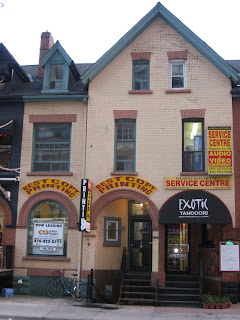 My old house was being leased after being occupied by a print shop for the past 25 years. I called up a realtor friend and asked her to show me through the house. Armed with a camera and notebook , I went in search of childhood memories, hoping the experience would trigger more than I’d been able to access to date. Although only the first floor and the basement were available to us, I tapped into the architecture in my mind and compared it to what remained that day.
Here are some of my notes from November 18, 2008.
I sucked in my breath as I entered my childhood home on Charles Street. Fifty-eight years since we moved. The main floor and basement were up for lease and a real estate agent friend arranged access for me. The first floor was stripped to the brick wall and studs. The original room divisions were obliterated. My stomach lurched.
I struggled to recognize the house of my childhood. The bones were still there, a few familiar markers. Outside I had climbed the metal stairs and heard a clanging sound instead of the thud of the former wooden steps. The hidey hole was still there under the front porch with its winding cement steps to the basement door. To my left in front of the basement window a cement pad replaced the metal doors of the chute to the coal bin below. The old front door had been replaced with a barred metal commercial entrance. Gone was the old carved glass windowed door with the bell to turn beneath. The transom above also looked different with a decorative metal flower in lieu of bars and the old curtained transom window opening inward probably considered a security risk.
In my mind’s eye the house I grew up in for the first 9 years was huge. The rooms seemed so spacious because of the very high ceilings. The living room faced the street with a large picture window. When I was nearly 4, I remember looking out into a white snowy night waiting for my mother to return with my baby brother. It was February 1945. Jim has just turned 62. Amazing that I can remember that night. There was a fireplace and mantel but it was never used. We had a radio, one of those big ones that stood on the floor. I used to lie in front with my head in the speakers to listen to a children’s program from Buffalo. I think it was called “Through the Garden Gate”. When I was 8, I even won a contest they held. I drew a picture of “The Garden Gate”. My prize was 2 tickets to the movie “The Wizard of Oz”. In the living room a stained glass window of a robin was behind the chesterfield. I used to love looking at it. Years later I saw someone removed it and probably put it in an antique shop. How sad to have it removed from its context. In the corner of the living room stood a big wooden box, low with a lid that opened up like a trunk. I think my Dad made it. I loved having my doll’s tea parties on it. The rest of the room is a blur, a carpet I think, a chair I recall my father reading his paper in. The painting on the wall of the Bow River; Sadie and I used to sit in front of it and make up stories cuddled under a blanket. One day the plaster ceiling came crashing down on my that wooden box. Luckily there were no tea parties in progress at the time.
(from earlier freewriting about my house)

Here are some of my notes from November 18, 2008.
I sucked in my breath as I entered my childhood home on Charles Street. Fifty-eight years since we moved. The main floor and basement were up for lease and a real estate agent friend arranged access for me. The first floor was stripped to the brick wall and studs. The original room divisions were obliterated. My stomach lurched.
I struggled to recognize the house of my childhood. The bones were still there, a few familiar markers. Outside I had climbed the metal stairs and heard a clanging sound instead of the thud of the former wooden steps. The hidey hole was still there under the front porch with its winding cement steps to the basement door. To my left in front of the basement window a cement pad replaced the metal doors of the chute to the coal bin below. The old front door had been replaced with a barred metal commercial entrance. Gone was the old carved glass windowed door with the bell to turn beneath. The transom above also looked different with a decorative metal flower in lieu of bars and the old curtained transom window opening inward probably considered a security risk.
In my mind’s eye the house I grew up in for the first 9 years was huge. The rooms seemed so spacious because of the very high ceilings. The living room faced the street with a large picture window. When I was nearly 4, I remember looking out into a white snowy night waiting for my mother to return with my baby brother. It was February 1945. Jim has just turned 62. Amazing that I can remember that night. There was a fireplace and mantel but it was never used. We had a radio, one of those big ones that stood on the floor. I used to lie in front with my head in the speakers to listen to a children’s program from Buffalo. I think it was called “Through the Garden Gate”. When I was 8, I even won a contest they held. I drew a picture of “The Garden Gate”. My prize was 2 tickets to the movie “The Wizard of Oz”. In the living room a stained glass window of a robin was behind the chesterfield. I used to love looking at it. Years later I saw someone removed it and probably put it in an antique shop. How sad to have it removed from its context. In the corner of the living room stood a big wooden box, low with a lid that opened up like a trunk. I think my Dad made it. I loved having my doll’s tea parties on it. The rest of the room is a blur, a carpet I think, a chair I recall my father reading his paper in. The painting on the wall of the Bow River; Sadie and I used to sit in front of it and make up stories cuddled under a blanket. One day the plaster ceiling came crashing down on my that wooden box. Luckily there were no tea parties in progress at the time.
(from earlier freewriting about my house)
I walk through the glass door from the now tiny front hall and see a brick wall straight ahead with some horizontal planks covering the old fireplace – now a chimney for the high-efficiency gas furnace. My bearings are lost. There are no room dividers and a big pile of debris fills the room. Remnants of one wall between the former kitchen and my parent’s former bedroom (really the dining room) tell me where the walls once were. The staircase is now walled and the once spacious hall is gone given over to the open room. The glass paneled French doors are gone to the living room and between the living room and dining room. We search around and find remnants of old plaster, high carved baseboards and window trim. The very high ceiling appears to be original and bears an old stamped pattern. But my favourite stained glass window with the robin on it is missing, as is the stained glass in the top of the rounded large picture window. I recall sitting on the back of the chesterfield looking at that robin in the stained glass before flipping myself backwards down to the cushions.
To be continued...
Have you ever gone looking for your past in old buildings or landscapes?
Is this the year to write your parent’s memoir?
Here is a post by Jerry Waxler that poses the question about writing your parents' memoir? I wonder if this is a necessary step to writing our own?
Is this the year to write your parent’s memoir?
Copyright © 2012, Ruth Zaryski Jackson
Is this the year to write your parent’s memoir?
Copyright © 2012, Ruth Zaryski Jackson
Your Memories, Your Book: To Tell the Truth
A useful article on truth telling in memoir from Personal Historian Wayne Groner:
Your Memories, Your Book: To Tell the Truth: The Plain Truth This article is a variation of my guest post on Sharon Lippincott’s blog, The Heart and Craft of Life Writing . A commo...
Copyright © 2011, Ruth Zaryski Jackson
Your Memories, Your Book: To Tell the Truth: The Plain Truth This article is a variation of my guest post on Sharon Lippincott’s blog, The Heart and Craft of Life Writing . A commo...
Copyright © 2011, Ruth Zaryski Jackson
My Interview in ArtScene
A few months ago I was asked by The PineRidge Arts Council to do an interview for the September-October issue of their publication ArtScene. I was excited to receive my copy today.
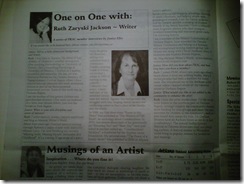
Since there is no online link and my BlackBerry photo is hard to read, I am publishing the interview here.
1. Tell us a little about your background and family.
I was born in Toronto, the eldest of four children of Ukrainian Canadian immigrants. After studying Anthropology at University of Toronto, then Counselling Psychology at University of Waterloo, I worked as a teacher, counsellor, and researcher. My last job was Historical Planner for the Ontario Ministry of Transportation’s Central Region where I documented heritage resources and made recommendations as part of the Environmental Assessment process. Some of this work was in Durham Region.
I am the mother of four grown children and grandmother of seven. I live with my husband on a farm near Mount Albert, just over the border in York Region.
2. What is your arts discipline and areas of interest?
I write memoir, poetry, creative nonfiction and blog at Memoir Writer’s World.
About four years ago, I started memoir writing through Ryerson University’s online course with instructor Allyson Latta. I’m now finishing my memoir “Missing Sadie, Missing Myself: Memories of a Childhood”.
It’s a coming of age story of a precocious daughter of Ukrainian immigrants uprooted from a downtown Toronto rooming house to follow her mother’s dream in 1950 of moving to the suburbs. Colourful characters, considered part of her extended family, were left behind. Against this background, she struggles with loss, longing, family secrets and conflicting values to find a place in her family and the world.
In 2008, my first short story “Room in My Heart” was published in "The Wisdom of Old Souls", an anthology about Grandmothers. In 2010, two poems about each of my grandmothers “Knowing You” and “Wash Day” were published in another anthology, "Grandmothers' Necklace", a fundraiser for the Stephen Lewis Foundation. My personal essay “The Power of a Family Secret” was published in 2010 on Allyson Latta’s website.
Besides writing and blogging, genealogy, learning to speak Ukrainian, and helping people with genealogical research, I am the family archivist and my present passion is picking up dropped threads in my family histories. I love to research some forgotten relative who died young or invented something and was never given credit. I’m rewriting history.
I am a member of the Writers’ Community of Durham Region, have attended the Ontario Writers’ Conference and belong to a dynamic and accomplished writing support group: Life Writers Ink along with Cheryl Andrews, Mary E. McIntyre and Anahita Printer Nepton.
My blog Memoir Writer’s World address: http://www.memoirwritersworld.blogspot.com/
3. How did you hear about PRAC and how long have you been a member?
I joined P.R.A.C. about two years ago when I heard about it from my writing buddy, Mary E. McIntyre who had been a member for many years. She introduced me to the Arts Scene newsletter where I learned about all the talented artists in Durham Region.
4. What would you like to see added to the community to enhance the arts?
I love the artist studio tours. I’d like to see more events in the northern part of Durham Region, stronger support for community theatre, more funding for Arts groups and more free arts activities for children in the community such as year round Arts camps for kids. Do Durham libraries have an Authors Series as we do in East Gwillimbury? The annual Stellar Literary Festival in Oshawa showcases local and emerging authors. A festival similar to WordsAlive could bring in popular writers for workshops and readings.
Post Script: The inaugural McLaughlin Literary Festival will be taking place at the Parkwood Estate in Oshawa on Sunday September 18, 2011.

Since there is no online link and my BlackBerry photo is hard to read, I am publishing the interview here.
1. Tell us a little about your background and family.
I was born in Toronto, the eldest of four children of Ukrainian Canadian immigrants. After studying Anthropology at University of Toronto, then Counselling Psychology at University of Waterloo, I worked as a teacher, counsellor, and researcher. My last job was Historical Planner for the Ontario Ministry of Transportation’s Central Region where I documented heritage resources and made recommendations as part of the Environmental Assessment process. Some of this work was in Durham Region.
I am the mother of four grown children and grandmother of seven. I live with my husband on a farm near Mount Albert, just over the border in York Region.
2. What is your arts discipline and areas of interest?
I write memoir, poetry, creative nonfiction and blog at Memoir Writer’s World.
About four years ago, I started memoir writing through Ryerson University’s online course with instructor Allyson Latta. I’m now finishing my memoir “Missing Sadie, Missing Myself: Memories of a Childhood”.
It’s a coming of age story of a precocious daughter of Ukrainian immigrants uprooted from a downtown Toronto rooming house to follow her mother’s dream in 1950 of moving to the suburbs. Colourful characters, considered part of her extended family, were left behind. Against this background, she struggles with loss, longing, family secrets and conflicting values to find a place in her family and the world.
In 2008, my first short story “Room in My Heart” was published in "The Wisdom of Old Souls", an anthology about Grandmothers. In 2010, two poems about each of my grandmothers “Knowing You” and “Wash Day” were published in another anthology, "Grandmothers' Necklace", a fundraiser for the Stephen Lewis Foundation. My personal essay “The Power of a Family Secret” was published in 2010 on Allyson Latta’s website.
Besides writing and blogging, genealogy, learning to speak Ukrainian, and helping people with genealogical research, I am the family archivist and my present passion is picking up dropped threads in my family histories. I love to research some forgotten relative who died young or invented something and was never given credit. I’m rewriting history.
I am a member of the Writers’ Community of Durham Region, have attended the Ontario Writers’ Conference and belong to a dynamic and accomplished writing support group: Life Writers Ink along with Cheryl Andrews, Mary E. McIntyre and Anahita Printer Nepton.
My blog Memoir Writer’s World address: http://www.memoirwritersworld.blogspot.com/
3. How did you hear about PRAC and how long have you been a member?
I joined P.R.A.C. about two years ago when I heard about it from my writing buddy, Mary E. McIntyre who had been a member for many years. She introduced me to the Arts Scene newsletter where I learned about all the talented artists in Durham Region.
4. What would you like to see added to the community to enhance the arts?
I love the artist studio tours. I’d like to see more events in the northern part of Durham Region, stronger support for community theatre, more funding for Arts groups and more free arts activities for children in the community such as year round Arts camps for kids. Do Durham libraries have an Authors Series as we do in East Gwillimbury? The annual Stellar Literary Festival in Oshawa showcases local and emerging authors. A festival similar to WordsAlive could bring in popular writers for workshops and readings.
Post Script: The inaugural McLaughlin Literary Festival will be taking place at the Parkwood Estate in Oshawa on Sunday September 18, 2011.
5 Things I Learned From Reading “Copernicus Avenue” by Andrew J. Borkowski
I grew up on the fringe of post World War Two Polish immigrant experience in Toronto. My family wasn’t Polish, they were Ukrainian. But my father grew up in Eastern Europe in Kasperivtsi, a village that was part of Malopolska, or ‘Little Poland’ between the two world wars. He was schooled in Polish and spoke it fluently. We had family friends who were Polish or ‘became Polish’ by marrying a Pole.

So when my friend Mary E. McIntyre recommended the Giller Prize-nominated book “Copernicus Avenue” to me, I read it with interest. Borkowski, in 16 linked short stories, gives us the urban Toronto Polish immigrant’s post-war experience along with the heartbreaking backstory of the Katyn and Baranica massacres. I learned five things reading the book.

So when my friend Mary E. McIntyre recommended the Giller Prize-nominated book “Copernicus Avenue” to me, I read it with interest. Borkowski, in 16 linked short stories, gives us the urban Toronto Polish immigrant’s post-war experience along with the heartbreaking backstory of the Katyn and Baranica massacres. I learned five things reading the book.
- 1. I learned or re-learned the power of landscape and memory when telling a story. Borkowski creates a fictitious street in the heart of the old Roncesvalles neighbourhood in Toronto’s west end. It could have been any Polish neighbourhood in any city, but for me it brought back memories of visiting friends in Parkdale and Roncesvalles as a child. In fact, the house on the cover looks exactly like the house some Polish friends lived in on Macdonnell Avenue, the eastern boundary of the Roncesvalles neighbourhood. On Saturdays my Dad would sometimes take us down to visit these friends and also to buy fresh Kielbasa and Paska or Kolach for the holidays. I can still remember the smell of the garlic sausage mixed with the aroma of sawdust scattered on the floor of the butcher shop. Borkowski evokes this neighbourhood through sensual details about bakeries, butcher shops, churches and statues, street life and the characters that inhabited the neighbourhood. I felt like I was back there with my Dad.
- I learned that memoir can be fiction and fiction can be memoir. In other words, the writer can choose the stories to tell and how to tell them. Life-based stories can be presented as fiction when the writer feels he doesn’t remember enough to make it a memoir, but he can still base the stories on his life and memories. Which is better? Neither. It depends what the writer wishes to achieve and how well he remembers his life.
- I learned that linked stories together can be like a memoir or a novel. Grouped together with the same characters and time and place, these stories form a coherent whole. Each story can stand on its own and might even be published individually, as in Borkowski’s case with his story ‘Twelve Versions of Lech’. An emerging writer can increase his chances of finding a book publisher by having already published some stories.
- I learned or I was reminded that I never really understood the Polish World War Two experience, though I'd met people who’d survived it. The problem was: no adult wanted to explain in detail to a curious child what had happened. Why was a Polish friend flying for the British Air Force? Shouldn’t he be in the Polish Air Force? Oh, wait a minute, Poland was invaded and disappeared from the map for a while. This book reveals the hidden wounds and resulting behaviors of these immigrant characters, all of which seem terribly familiar to me. I learned about the horrors of Polish deportation to Siberia from Jane/Janina Boruszewski and I’m still learning subtle details of survival.
- I learned how historical details (backstory) can be woven into the story in description, character, plot and dialogue, without weighing down the flow of the story. Now to figure out how to do that myself!
“Perhapsing” Cleopatra: Ideas for Speculating About My Grandmother’s Life
I have just finished reading “Cleopatra: A Life” by Stacy Schiff and her style has given me some ideas about writing about my grandmother’s life.
![]() The content of their lives could not have differed more. Cleopatra, born in 69 B.C., a queen at 18, ruler of Egypt for 22 years, lover of two of the most famous men in history, Julius Caesar and Mark Antony, she amassed wealth beyond imagination.
The content of their lives could not have differed more. Cleopatra, born in 69 B.C., a queen at 18, ruler of Egypt for 22 years, lover of two of the most famous men in history, Julius Caesar and Mark Antony, she amassed wealth beyond imagination.
My grandmother, Marya Huckan Zarecka, an illiterate Ukrainian peasant woman born in 1880 in Repuzhintsy, a small village in Bukovina, daughter of a mayor, was married off to a poor and unstable husband and sent to homestead in the wilds of Canada. Both women were mothers, the only similarity. About both, little was passed down apart from stories and myth.
Using detailed research and a lot of speculation, Schiff tells a brilliant story about Cleopatra’s life. Her book could have been titled: “Perhapsing Cleopatra”. She provides a master lesson in imagining and detailing a life where few facts survived.
My grandmother lived a quiet life, out-shadowed by her disruptive husband. She kept a low profile to avoid his wrath and encouraged her children to do likewise. Not many stories about her were passed down, and if they were, consisted of vague remarks like “ oh, she was wonderful”, but with few meaty details.
I realized after reading "Cleopatra A Life" that I did in fact possess enough information about my grandmother from photos, interviews with my mother and other siblings and cousins, and my grandfather’s hospital records to tell her story using the same techniques that Stacy Schiff used to bring Cleopatra to life. I went back to Schiff’s book and looked for phrases and words she used to recreate colourful, textured scenes and speculate about feelings and motives.
Besides the word perhaps, some other words and phrases used to fill out her story were: maybe, suppose, wonder, imagine, we don’t know if, what if, what she didn’t know, possibly, might have/could have/must have, perchance, suggests, no doubt she…, it seems as if…, she had no choice but to…, these might have been the possibilities, it is likely/unlikely, there is no reason to assume/we can safely assume, it would have been…, we have no proof that…, and so on.
Just as Stacy Schiff reconstructed Cleopatra’s life, I can now tell my Baba’s story by using conjecture and guesses to assess shrewdly her probable and possible motives and hypothesize what she was thinking and feeling decades ago.
(For tips on speculating, see Lisa Knopp's Brevity craft essay: "Perhapsing": The Use of Speculation in Creative Nonfiction.)

My grandmother, Marya Huckan Zarecka, an illiterate Ukrainian peasant woman born in 1880 in Repuzhintsy, a small village in Bukovina, daughter of a mayor, was married off to a poor and unstable husband and sent to homestead in the wilds of Canada. Both women were mothers, the only similarity. About both, little was passed down apart from stories and myth.
Using detailed research and a lot of speculation, Schiff tells a brilliant story about Cleopatra’s life. Her book could have been titled: “Perhapsing Cleopatra”. She provides a master lesson in imagining and detailing a life where few facts survived.
My grandmother lived a quiet life, out-shadowed by her disruptive husband. She kept a low profile to avoid his wrath and encouraged her children to do likewise. Not many stories about her were passed down, and if they were, consisted of vague remarks like “ oh, she was wonderful”, but with few meaty details.
I realized after reading "Cleopatra A Life" that I did in fact possess enough information about my grandmother from photos, interviews with my mother and other siblings and cousins, and my grandfather’s hospital records to tell her story using the same techniques that Stacy Schiff used to bring Cleopatra to life. I went back to Schiff’s book and looked for phrases and words she used to recreate colourful, textured scenes and speculate about feelings and motives.
Besides the word perhaps, some other words and phrases used to fill out her story were: maybe, suppose, wonder, imagine, we don’t know if, what if, what she didn’t know, possibly, might have/could have/must have, perchance, suggests, no doubt she…, it seems as if…, she had no choice but to…, these might have been the possibilities, it is likely/unlikely, there is no reason to assume/we can safely assume, it would have been…, we have no proof that…, and so on.
Just as Stacy Schiff reconstructed Cleopatra’s life, I can now tell my Baba’s story by using conjecture and guesses to assess shrewdly her probable and possible motives and hypothesize what she was thinking and feeling decades ago.
(For tips on speculating, see Lisa Knopp's Brevity craft essay: "Perhapsing": The Use of Speculation in Creative Nonfiction.)
Write your life—guest post by Marion Roach Smith
Here are some interesting tips on writing about your life from The Book Case on The Book Page Blog:
Write your life—guest post by Marion Roach Smith
Copyright © 2010, Ruth Zaryski Jackson
Write your life—guest post by Marion Roach Smith
Copyright © 2010, Ruth Zaryski Jackson
Authenticity: What’s Right For You?
As I listened to Kay Adams talk on NAMW’s Teleseminar a few weeks ago on Journey to the Self, I was reminded of this question a therapist once asked me. I puzzled over the question. The answer felt as elusive as a butterfly’s wing moving to the next flower. Over the years I’ve become more comfortable with the question "What's right for you, Ruth?" though the answers are still sometimes hard to find.
Kay’s talk on authenticity linked this question to my current writing. At the heart of memoir writing is the self, telling the story of our lives as we remember it, as we experienced it, as we prioritized the events in our memories, and as we emotionally felt it. Our authentic self with our own unique needs and core values is the voice we tap into when we are searching for the inner voice, the real ‘me’ coming up from the unconscious. The story told by this authentic inner voice is the truth, our ‘emotional truth’ that is always guiding us through the scenes and memories. Authenticity has to do with our core values and living in alignment with what is right for us says Kay.
My wise therapist many years ago, was really asking me to drop down into the real me, to get in touch with the core values that were being quashed. He was asking me to come home to myself and ask what is stopping me from living my authentic self. When we feel down, something isn’t right with our core values. We feel stuck, insecure or angry. We need to ask ourselves what core value is not being respected here? In our memoir writing, the voice of our story makes more sense when it comes from our authentic self and our authentic core values.
But how do we figure out what our core values are? And how do they differ from those of our family? This is what confused me about the question: "What’s right for you, Ruth? I hadn’t articulated my true values and distinguished them from those of my family of origin or from my husband’s and his family of origin. Caught in this tangled web, I was floundering.
Since I started my memoir I have writtten about my parents’ core values, but not mine. Before I go any further with my writing I need to do this exercise to see how my core values and my family's differ or mesh.
Kay’s talk on authenticity linked this question to my current writing. At the heart of memoir writing is the self, telling the story of our lives as we remember it, as we experienced it, as we prioritized the events in our memories, and as we emotionally felt it. Our authentic self with our own unique needs and core values is the voice we tap into when we are searching for the inner voice, the real ‘me’ coming up from the unconscious. The story told by this authentic inner voice is the truth, our ‘emotional truth’ that is always guiding us through the scenes and memories. Authenticity has to do with our core values and living in alignment with what is right for us says Kay.
My wise therapist many years ago, was really asking me to drop down into the real me, to get in touch with the core values that were being quashed. He was asking me to come home to myself and ask what is stopping me from living my authentic self. When we feel down, something isn’t right with our core values. We feel stuck, insecure or angry. We need to ask ourselves what core value is not being respected here? In our memoir writing, the voice of our story makes more sense when it comes from our authentic self and our authentic core values.
But how do we figure out what our core values are? And how do they differ from those of our family? This is what confused me about the question: "What’s right for you, Ruth? I hadn’t articulated my true values and distinguished them from those of my family of origin or from my husband’s and his family of origin. Caught in this tangled web, I was floundering.
Since I started my memoir I have writtten about my parents’ core values, but not mine. Before I go any further with my writing I need to do this exercise to see how my core values and my family's differ or mesh.
What is My Voice?

Since then, I have been thinking about my voice and wondering just what it is? I have a soft voice that wouldn’t project when I was in the drama club at Northview Collegiate. I have a quietly intelligent voice. I have a thoughtful voice. I have an inquiring voice. I don’t speak without thinking. I’m not quick to draw attention or promote myself. On the page, I lean towards a more journalistic style, listing facts and documenting my points. Is it only an inviting engaging voice that entices the reader to go on? Do you have to be an Irish story-teller to captivate an audience?
A challenge Charles didn’t address was how to capture my child’s voice, maybe age 6 or 7 and then grow myself up to the concluding chapters of my memoir. How do I move my voice along as I change? I know I did change. My effervescent child’s voice was stifled in adolescence. I became shy and introverted. Then I gradually reasserted myself. Can change be shown by picking several points along my timeline to illustrate the differences? What do you think?
Any thoughts on voice?
Back To My Memoir
By now most of you will be wondering when I’m going to stop writing about my great-aunt Lena. Between Christian Cassidy's research and my own, we have exhausted the topic. Apart from some LDS research I need to do before erecting a monument on her grave at Brookside Cemetery, I’m finished. We now know far more about her life and death than we ever did before. This exercise illustrates the amount of detail that can be gleaned from genealogical, archival and geographical research to bring to life the characters of your memoir. The family photos, news coverage from the fire and a lot of 'perhapsing' resulted in a real person coming to life on the page. I will leave this topic for now and move back to my memoir which has been lying fallow these many months.
After writing the first draft of what I thought was the first two thirds of my story, I got stuck on where and how to end it. I played around with various possibilities but nothing felt right to me. Advice from my writing pals and teacher didn't help either. The unexpected death of our daughter Milo in May 2010 and other family demands crowded in on my writing time. I distracted myself with genealogical research on my husband's family and setting up another blog. I even considered chucking my memoir!
 A few weeks ago when playing on Facebook or Twitter, I can't remember quite how, I came upon the website of James FitzGerald, a Toronto author and journalist. I then connected to the Random House site where the first chapter of his latest book, WHAT DISTURBS OUR BLOOD is available. The power of his voice knocked me out. I could see how he deftly braided together the threads of a complex (far more so than mine) family and personal memoir as well as a medical history of his prominent grandfather and father told from the voice of the boy, himself. Suddenly, I could see a way forward for my story.
Now I'm writing again and it will be in my voice, my style, my weaving of the threads of my own story. You never know where the inspiration will come from. Just keep reading. The writing will follow.
Copyright © 2011, Ruth Zaryski Jackson
After writing the first draft of what I thought was the first two thirds of my story, I got stuck on where and how to end it. I played around with various possibilities but nothing felt right to me. Advice from my writing pals and teacher didn't help either. The unexpected death of our daughter Milo in May 2010 and other family demands crowded in on my writing time. I distracted myself with genealogical research on my husband's family and setting up another blog. I even considered chucking my memoir!
Now I'm writing again and it will be in my voice, my style, my weaving of the threads of my own story. You never know where the inspiration will come from. Just keep reading. The writing will follow.
Copyright © 2011, Ruth Zaryski Jackson
Tracing Lena Huckan – Part One (Ben Nevis House) Guest Post by Christian Cassidy (This Was Winnipeg)
After writing my "Letters to a Dead Great-Aunt" series, I made the acquaintance of Christian Cassidy, a local Winnipeg historian who writes several blogs. He offered to do some additional research for me in Winnipeg to uncover more about the life and death of my Great-Aunt Michalena in a hotel fire in 1918. Here in his guest post is Part One, based on information found in the 1915 Henderson Directory for Winnipeg. Lena was listed as living in Ben Nevis House at 42 Dagmar Street.
Tracing Lena Huckan
Ben Nevis House

The name "Ben Nevis House" (named for the highest mountain in Great Britain) does not appear in ads until June 1907.

An advertisement in 1917 says that Ben Nevis House is the "first house from Notre Dame". If that is the case then this is a picture of Lena‟s neighbourhood circa 1903. It's a photo looking up Notre Dame FROM Dagmar so that would be her streetcar, taking her to and from the city core.
Could Lena have worked at Ben Nevis as well as live there, similar to what she did (later) at the Riverview (Hotel)? Ben Nevis House routinely had ads similar to this in the papers. From March 14, 1913:
Ben Nevis House was a regular advertiser and not just with little classified ads but larger ones in amongst city hotels; so it may have been a little high end, perhaps out of Lena's price range.
Other mentions of Ben Nevis around the time she may have been living there:

Perhaps had some fun while she lived there….
Caledonian Sports Witnessed by Large Crowd at Horse Show Building Last Night. October 5, 1910 MB Free Press
Close on 3,000 people witnessed the first annual Caledonian games at the Horse Show amphitheatre last night. Mixed in with the Scotch music and dancing were the more common athletic sport.
Tug- of war - Caledonians swept everything before them in this contest. They first defeated the Electrical Union team in two straight -pulls and then did the same thing, only more easily, to a team
from the Ben Nevis house.
The Neighbourhood
All of the houses on that first block of Dagmar, and parallel streets, are now gone. That stretch of Notre Dame is fairly commercial with some light industrial and as the Notre Dame buildings expanded, the houses directly behind them disappeared.


These are photos of houses within a couple of blocks of Ben Nevis House and, presumably, would be similar in size or style. Dagmar wasn't noted for being a remarkable street in comparison to the rest of the neighbourhood.
Central Park


Given where she lived, she definitely would have visited Central Park, just a couple of blocks to the south. ( http://winnipegdowntownplaces.blogspot.com/2010/09/downtown-places-central-park.html )
Central Park was one of Winnipeg's first parks. It was originally a natural space, but
by the time she lived there, the park would have boasted tennis courts, a bandshell and the Waddell Fountain. It was a very popular place and you can see the treeline from where she lived.

Some of the old houses and buildings exist around the park. Knox Church (above) was built between 1914 and 1918 (the war interrupted). The Warwick, Winnipeg's first upscale apartment block, was there in 1909. (for more on the Warwick: http://winnipegdowntownplaces.blogspot.com)

One feature that was unveiled in 1914 was the Waddell Fountain. It was an attraction unto itself. This summer, in fact, the fountain was re-installed after a complete rebuild and upgrade.
More on the fountain and the interesting story behind it http://www.gov.mb.ca/chc/hrb/prov/p078.html)
Other period shots of Central Park:
http://peel.library.ualberta.ca/postcards/PC002133.html
Tracing Lena Huckan
Ben Nevis House
In 1903 advertisements begin to appear for "rooms for rent" at 42 Dagmar. At first it was three, then four rooms.


The Morning Telegram -- July 19, 1907
The name "Ben Nevis House" (named for the highest mountain in Great Britain) does not appear in ads until June 1907.

Notre Dame from Dagmar ca. 1903 Source: http://virtual.heritagewinnipeg.com/windowPhoto.php?fileNum=%2002-299&tName=downtown
An advertisement in 1917 says that Ben Nevis House is the "first house from Notre Dame". If that is the case then this is a picture of Lena‟s neighbourhood circa 1903. It's a photo looking up Notre Dame FROM Dagmar so that would be her streetcar, taking her to and from the city core.
Could Lena have worked at Ben Nevis as well as live there, similar to what she did (later) at the Riverview (Hotel)? Ben Nevis House routinely had ads similar to this in the papers. From March 14, 1913:
Classified (Manitoba Free Press)
SMART GIRL WANTED AT ONCE FOR
upstairs and wait table. $20. Ben Nevis House. 42 Dagmar Street.
SMART GIRL WANTED AT ONCE FOR
upstairs and wait table. $20. Ben Nevis House. 42 Dagmar Street.
Ben Nevis House was a regular advertiser and not just with little classified ads but larger ones in amongst city hotels; so it may have been a little high end, perhaps out of Lena's price range.
Other mentions of Ben Nevis around the time she may have been living there:

The Voice -- August 3, 1917
Perhaps had some fun while she lived there….
Caledonian Sports Witnessed by Large Crowd at Horse Show Building Last Night. October 5, 1910 MB Free Press
Close on 3,000 people witnessed the first annual Caledonian games at the Horse Show amphitheatre last night. Mixed in with the Scotch music and dancing were the more common athletic sport.
Tug- of war - Caledonians swept everything before them in this contest. They first defeated the Electrical Union team in two straight -pulls and then did the same thing, only more easily, to a team
from the Ben Nevis house.
The Neighbourhood
All of the houses on that first block of Dagmar, and parallel streets, are now gone. That stretch of Notre Dame is fairly commercial with some light industrial and as the Notre Dame buildings expanded, the houses directly behind them disappeared.

Period House near Bannatyne Ave. and Notre Dame http://www.flickr.com/photos/christiansphotos/5138797512/
There are still pockets of period houses in the neighborhood. 
Period houses on Bannatyne Ave http://www.flickr.com/photos/christiansphotos/5138186391
These are photos of houses within a couple of blocks of Ben Nevis House and, presumably, would be similar in size or style. Dagmar wasn't noted for being a remarkable street in comparison to the rest of the neighbourhood.
Central Park

Central Park ca. 1918 http://www.virtual.heritagewinnipeg.com/windowPhoto.php?fileNum=%2002-194&tName=downtown

Street around Central Park ca. 1912 http://www.virtual.heritagewinnipeg.com/windowPhoto.php?fileNum=%2002-071&tName=downtown
Given where she lived, she definitely would have visited Central Park, just a couple of blocks to the south. ( http://winnipegdowntownplaces.blogspot.com/2010/09/downtown-places-central-park.html )
Central Park was one of Winnipeg's first parks. It was originally a natural space, but
by the time she lived there, the park would have boasted tennis courts, a bandshell and the Waddell Fountain. It was a very popular place and you can see the treeline from where she lived.

Some of the old houses and buildings exist around the park. Knox Church (above) was built between 1914 and 1918 (the war interrupted). The Warwick, Winnipeg's first upscale apartment block, was there in 1909. (for more on the Warwick: http://winnipegdowntownplaces.blogspot.com)

One feature that was unveiled in 1914 was the Waddell Fountain. It was an attraction unto itself. This summer, in fact, the fountain was re-installed after a complete rebuild and upgrade.
More on the fountain and the interesting story behind it http://www.gov.mb.ca/chc/hrb/prov/p078.html)
Other period shots of Central Park:
http://peel.library.ualberta.ca/postcards/PC002133.html
Copyright © 2010, Christian Cassidy for Ruth Zaryski Jackson
Building the Alaska Highway: Dad's Story
Last Thursday on Remembrance Day I planned to write about my Dad’s contribution to the war effort, building the Alaska Highway. My parents, married in October 1939 just weeks after WW11 broke out, were living and working in Toronto. By 1940 in Canada conscription had been introduced for home defence and Dad was worried. After witnessing WW1 as a child in Europe, he had no appetite for active service.
In 1941, months after I was born, my father took a job with Curran and Briggs, a paving and construction company with the first Canadian contract to work on the construction of the Alaska Highway. My father made that decision without consulting my mother, so she was very angry he was going off for a year, leaving her with a newborn baby and a rooming house to manage in downtown Toronto. From his point of view, it was an opportunity to work at his trade as a welder and earn a lot of money. After finishing a welding course at night school, he’d found it difficult to obtain work in his trade in the 1930s and continued to work in the restaurant business out of necessity. He first heard about the job from a friend, Fred Caruk, who owned Master Welding in Port Credit, just west of Toronto. When Dad was offered a chance to work as welder maintaining all machinery and equipment for this paving company, he saw it as a great chance and a bit of an adventure. It also gave him a way of contributing to the war effort.
An Alaska Highway had been proposed and debated in the 1930s, but it wasn’t until fear of a Japanese invasion via Siberia and the Japanese bombing of Pearl Harbour in 1941, that such a road, as a supply route, was thought to be essential for the defence of North America. On February 11, 1942 President Roosevelt officially authorized work to begin by the United States Army Engineer Troops.
According to family lore, my father was already in Alaska by September 1941. He travelled by train from Union Station in Toronto to Edmonton and from there to Dawson Creek, BC. Over the year he would travel with his firm as they advanced construction from Dawson Creek to the highway's middle point. Others were working from Fairbanks, east to the middle point at around Watson Lake.
Working and living conditions were extremely difficult with temperatures ranging from 90 degrees F. to -70 degrees F. Swamps, rivers, ice, cold, mosquitoes, flies and gnats tested the men daily. Most camps were kept open and machinery operated on a 22 hour basis, with 11 hour shifts. Trying to maintain equipment not designed for such conditions, was an ongoing challenge to the creativity of men like my father.
While Dad was in Alaska, Mom would tell me stories about him and read his letters to me. After about a year my dad came home for a two month visit when I was about 18 months old. I have no recollection of his visit in October 1942, only the family story that I cried and clung to him in Union Station when he boarded the train to return.
The highway officially opened November 1942, though improvements continued to be made for months and years later. Dad worked in Alaska for another 4 months before coming home for good in about February 1943, just before I turned two years old.
I have no memory of his return or the events that followed. The story is that he returned with $30,000 and invested it in a business partnership that went sour. The money vanished and Mom continued for another seven years to run the rooming house and save her meager dollars for a down payment on her dream house in the suburbs. Ashamed of his bad judgement and grateful for Mom's forgiveness, my father started his own welding business, Ontario Collision and Welding. He persevered and was successful.
Copyright © 2010, Ruth Zaryski Jackson
In 1941, months after I was born, my father took a job with Curran and Briggs, a paving and construction company with the first Canadian contract to work on the construction of the Alaska Highway. My father made that decision without consulting my mother, so she was very angry he was going off for a year, leaving her with a newborn baby and a rooming house to manage in downtown Toronto. From his point of view, it was an opportunity to work at his trade as a welder and earn a lot of money. After finishing a welding course at night school, he’d found it difficult to obtain work in his trade in the 1930s and continued to work in the restaurant business out of necessity. He first heard about the job from a friend, Fred Caruk, who owned Master Welding in Port Credit, just west of Toronto. When Dad was offered a chance to work as welder maintaining all machinery and equipment for this paving company, he saw it as a great chance and a bit of an adventure. It also gave him a way of contributing to the war effort.
 |
| Jack Zaryski Pulling Welding Machine for Curran & Briggs c. 1942 |
An Alaska Highway had been proposed and debated in the 1930s, but it wasn’t until fear of a Japanese invasion via Siberia and the Japanese bombing of Pearl Harbour in 1941, that such a road, as a supply route, was thought to be essential for the defence of North America. On February 11, 1942 President Roosevelt officially authorized work to begin by the United States Army Engineer Troops.
According to family lore, my father was already in Alaska by September 1941. He travelled by train from Union Station in Toronto to Edmonton and from there to Dawson Creek, BC. Over the year he would travel with his firm as they advanced construction from Dawson Creek to the highway's middle point. Others were working from Fairbanks, east to the middle point at around Watson Lake.
 |
| Route of Alaska Highway Govt. of Alberta |
 |
| Jack Zaryski aka. Johnny the Welder |
While Dad was in Alaska, Mom would tell me stories about him and read his letters to me. After about a year my dad came home for a two month visit when I was about 18 months old. I have no recollection of his visit in October 1942, only the family story that I cried and clung to him in Union Station when he boarded the train to return.
The highway officially opened November 1942, though improvements continued to be made for months and years later. Dad worked in Alaska for another 4 months before coming home for good in about February 1943, just before I turned two years old.
 |
| Alaska Highway Dawson Creek, B.C. c. 1940s |
Copyright © 2010, Ruth Zaryski Jackson
Working in Cranberry Portage, Manitoba 1930
My Mother celebrated her 97th birthday a few weeks ago. Still alert and mobile, she says she might now make it to 100! A remarkable feat for someone who never knew as a child if they would have enough to eat. She went to work at fifteen to help the family. In 1930, when she was sixteen, she ended up working in Cranberry Portage, a booming frontier town in northern Manitoba.
In 1928, a devastating forest fire had swept a large part of the old town built of logs and wood. I asked my mother to tell me how she came to work in Cranberry Portage, Manitoba in 1930, just two years after the big fire.
She told me: "jobs just seemed to land in my lap, one after another".
One day she was walking down the street with a friend in Winnipegosis and saw a "Help Wanted" notice in a store window. A woman was looking for a person to come to Cranberry Portage with her family to help cook and look after their three children. Her husband worked at a gravel pit while the woman had a job cooking for a camp of men who worked along the railway track outside of Cranberry Portage. Mom couldn’t remember if it was a mining camp or a lumber camp. Most likely it was a camp for C.N.R. workers who were laying eighty-seven miles of railroad track to a wilderness tent town of Flin Flon. Mrs. Anderson, Mom recalled, was a woman of Polish and Icelandic descent. While Mom worked for her for about a month, they lived in a tent which was actually a temporary frame building with a canvas roof tied on top.
When Mrs. Anderson no longer needed Mom, she was offered a job at the Redwing Café Store Bakery as a waitress and helper, replacing a Swedish nineteen year old boy who had gone home for a month. After a month, Mom was asked to stay on, and the other hired girl left to help relatives who had just come to town to open a restaurant.
"Hutch" and his family owned the café. His wife was Norwegian or Swedish from Seattle, Washington and his mother also lived with them. Mom recalls she worked there for three or four months. She knows for sure she was there for her seventeenth birthday on October 23rd. Likely she went for the summer season in June or July and left in November.
When I think about what I was doing at age sixteen or seventeen, or what my children and grandchildren are doing, I think my mother was courageous to take a job so far from her home in Sclater, Manitoba and go to a northern town full of mostly men of a hundred different nationalities. She set the adventure bar high for all of us and we are so grateful. Happy Birthday, Mom.
Copyright © 2010, Ruth Zaryski Jackson
In 1928, a devastating forest fire had swept a large part of the old town built of logs and wood. I asked my mother to tell me how she came to work in Cranberry Portage, Manitoba in 1930, just two years after the big fire.
She told me: "jobs just seemed to land in my lap, one after another".
One day she was walking down the street with a friend in Winnipegosis and saw a "Help Wanted" notice in a store window. A woman was looking for a person to come to Cranberry Portage with her family to help cook and look after their three children. Her husband worked at a gravel pit while the woman had a job cooking for a camp of men who worked along the railway track outside of Cranberry Portage. Mom couldn’t remember if it was a mining camp or a lumber camp. Most likely it was a camp for C.N.R. workers who were laying eighty-seven miles of railroad track to a wilderness tent town of Flin Flon. Mrs. Anderson, Mom recalled, was a woman of Polish and Icelandic descent. While Mom worked for her for about a month, they lived in a tent which was actually a temporary frame building with a canvas roof tied on top.
 |
| Mrs. Harry Anderson Cranberry Portage, MB 1930 |
When Mrs. Anderson no longer needed Mom, she was offered a job at the Redwing Café Store Bakery as a waitress and helper, replacing a Swedish nineteen year old boy who had gone home for a month. After a month, Mom was asked to stay on, and the other hired girl left to help relatives who had just come to town to open a restaurant.
 |
| My mother, Jean Zaretsky far right, Petersen/Schamerhorn family, owners of Redwing Cafe Store Bakery, Cranberry Portage, MB 1930 |
"Hutch" and his family owned the café. His wife was Norwegian or Swedish from Seattle, Washington and his mother also lived with them. Mom recalls she worked there for three or four months. She knows for sure she was there for her seventeenth birthday on October 23rd. Likely she went for the summer season in June or July and left in November.
 |
| Jean Zaretsky age 17 Cranberry Portage, MB 1930 |
When I think about what I was doing at age sixteen or seventeen, or what my children and grandchildren are doing, I think my mother was courageous to take a job so far from her home in Sclater, Manitoba and go to a northern town full of mostly men of a hundred different nationalities. She set the adventure bar high for all of us and we are so grateful. Happy Birthday, Mom.
Copyright © 2010, Ruth Zaryski Jackson
Pit Lit and Writing Your Memoir
I sat riveted to the TV last night watching with the world as the 33 Chilean miners were rescued at the San Jose mine. While overcome with awe and joy, I also thought: What an incredible story! Sure enough, among the journalists given free access during the miners' 70 days of entombment, one has announced a book deal already. Jonathan Franklin of The Guardian will have his book "33 Men" published by Transworld in 2011.Other TV, book and movie rights are pending.
Then I felt depressed. My lifestory isn’t nearly as engaging, dramatic or unusual as those stories. Who would want to read my story when they could read a Pit Lit memoir? Why bother telling my boring little tale?
After I’d cried a bit and given myself a little shake, I thought about it. I’m not famous. I don’t have authors bugging me to ghost write my autobiography. But, if I didn’t tell my story, who would? The fact is : my life is my story, no one else’s. I’m the only one who can tell it my way. My brothers have their own take on our shared histories. My sister who is 10 years younger, has her story. My parents’ stories are their stories and form only the backdrop to my own.
It’s difficult to give yourself permission to write or continue writing your memoir. It’s a contract with yourself that has to be renewed daily. We play little games to trick ourselves into writing. I’ll just write it down. Maybe I will cut it out later. Pretend that this is a story in the 3rd person and what is happening is happening to another girl, not to you.
When we do this and produce a scene or two, we are still self-critical and often tempted to chuck it. The best thing to do is wait. Put it aside and wait a day, a week or months. Often in the fresh light of another day , what we thought was garbage, now looks brilliant, or at least salvageable for a first draft of our memoir. The lesson here is to write, keep writing, and save everything. You may not in the end, have a memoir like one of the Chilean miners, but you will have your memoir and someone will want to read it. You may be surprised how many.
Copyright © 2010, Ruth Zaryski Jackson
Then I felt depressed. My lifestory isn’t nearly as engaging, dramatic or unusual as those stories. Who would want to read my story when they could read a Pit Lit memoir? Why bother telling my boring little tale?
After I’d cried a bit and given myself a little shake, I thought about it. I’m not famous. I don’t have authors bugging me to ghost write my autobiography. But, if I didn’t tell my story, who would? The fact is : my life is my story, no one else’s. I’m the only one who can tell it my way. My brothers have their own take on our shared histories. My sister who is 10 years younger, has her story. My parents’ stories are their stories and form only the backdrop to my own.
It’s difficult to give yourself permission to write or continue writing your memoir. It’s a contract with yourself that has to be renewed daily. We play little games to trick ourselves into writing. I’ll just write it down. Maybe I will cut it out later. Pretend that this is a story in the 3rd person and what is happening is happening to another girl, not to you.
When we do this and produce a scene or two, we are still self-critical and often tempted to chuck it. The best thing to do is wait. Put it aside and wait a day, a week or months. Often in the fresh light of another day , what we thought was garbage, now looks brilliant, or at least salvageable for a first draft of our memoir. The lesson here is to write, keep writing, and save everything. You may not in the end, have a memoir like one of the Chilean miners, but you will have your memoir and someone will want to read it. You may be surprised how many.
Copyright © 2010, Ruth Zaryski Jackson
" Life Goes On But Your Memoir Mustn't"
After attending a two-day workshop last week called “Illuminating the Path: Finding Theme and Structure in Your Memoir” with Allyson Latta, I try to sort out my notes, my thoughts and wonder how it all applies to my story.
“Life goes on but your memoir mustn’t”, a quote from Adair Lara in Writer’s Digest, became our mantra and challenge. Where do I start and finish my story? How do I construct the narrative arc of my story?
Should I begin chronologically with my early life on Charles Street then move on to the suburbs and what develops there? Or should I start with the move, flash back to longing for my early life in the rooming house, then move on to the crisis, climax and resolution? Another possibility is to start with moving back to the city for university (in the neighbourhood of Charles Street), then reflect on memories of my early years. I wasn’t planning to write about this period in university but my writing group tend to favour this approach. I had another idea about my life on Charles Street but I think this would work better as a short story, so I will set that option aside.
According to Adair Lara and Tristine Rainer, to figure out the narrative arc, the emotional framework of your memoir, you must figure out ‘the desire line’. What is it that you want? This is what drives the narrative and moves the character to the conclusion. In “Elements of Effective Arc” (Writer's Digest July/August 2010)Adair Lara suggests jotting down a list of actions and obstacles:
I wanted _______________ (the desire line).
To get it I______________ (action).
To get it, I then____________ (action)
But ______________ (obstacle) got in my way.
So, I _____________________ (action).
(And so on.)
When I look at this framework, I think that my over arching desire line was to go home again, ie. to go back to the place where I felt confident and secure. What I need to do now is to examine each scene of my memoir and identify my desire line, actions and obstacles for each step of my journey.
Have you identified your ‘desire line’?
Copyright © 2010, Ruth Zaryski Jackson
“Life goes on but your memoir mustn’t”, a quote from Adair Lara in Writer’s Digest, became our mantra and challenge. Where do I start and finish my story? How do I construct the narrative arc of my story?
Should I begin chronologically with my early life on Charles Street then move on to the suburbs and what develops there? Or should I start with the move, flash back to longing for my early life in the rooming house, then move on to the crisis, climax and resolution? Another possibility is to start with moving back to the city for university (in the neighbourhood of Charles Street), then reflect on memories of my early years. I wasn’t planning to write about this period in university but my writing group tend to favour this approach. I had another idea about my life on Charles Street but I think this would work better as a short story, so I will set that option aside.
According to Adair Lara and Tristine Rainer, to figure out the narrative arc, the emotional framework of your memoir, you must figure out ‘the desire line’. What is it that you want? This is what drives the narrative and moves the character to the conclusion. In “Elements of Effective Arc” (Writer's Digest July/August 2010)Adair Lara suggests jotting down a list of actions and obstacles:
I wanted _______________ (the desire line).
To get it I______________ (action).
To get it, I then____________ (action)
But ______________ (obstacle) got in my way.
So, I _____________________ (action).
(And so on.)
When I look at this framework, I think that my over arching desire line was to go home again, ie. to go back to the place where I felt confident and secure. What I need to do now is to examine each scene of my memoir and identify my desire line, actions and obstacles for each step of my journey.
Have you identified your ‘desire line’?
Copyright © 2010, Ruth Zaryski Jackson
The Power of a Family Secret
My personal essay The Power of A Family Secret has now been posted on Allyson Latta's new website. This essay appeared in an earlier version in several blog posts on this site. Please click on the title of my essay or Allyson's name, have a look and let me know what you think.
Copyright © 2010, Ruth Zaryski Jackson
Copyright © 2010, Ruth Zaryski Jackson
Letter to My Dead Great-Aunt Part Three
My mother told me Uncle John didn’t like to spend money but as your next of kin, he would have been the one responsible for your burial. I wondered if he had done nothing to commemorate your life. Maybe your body was never recovered. Maybe he was too overcome with grief. I wished I had asked Auntie Huckan, his wife but I hadn’t known about you then. I wished my mother had asked her but she didn’t think to ask. I found the details of your burial by chance and more details on your Death Certificate.
Armed with the name of the hotel where you died and the exact date of the fire, I pressed on and tried to find a photograph of the building. The Riverview Hotel had been built in 1906 or earlier (Henderson Directory 1906) and a large 1-storey addition of wood construction had been added in 1914. The Winnipeg architect, Charles S. Bridgeman designed it for the owner, J.J. O'Connell in 1913. No photograph was found but an interesting discovery showed up in the city records.
Negligence
I discovered on the Building Permit for the addition, the owner J.J. O'Connell had on June 11, 1914 been “convicted and reprimanded for not complying with Notice issued January 7, 1914 re Exit doors”. A Building Inspector had deemed the building dangerous four years before the fire! Maybe even before you were hired.
The Historical Buildings Officer for Winnipeg sent me several newspaper clippings about the fire on the night of February 5, 1918 when the Riverview Hotel burned to the ground. Three perished in the fire: a nurse employed by the owner, a veteran of WWI and you, my dear Great-Aunt Michalena, described as “Lena Wuchan, kitchen girl” and “Lena Guchan, kitchen maid”. They couldn’t even spell your name right.
Here’s what happened as I can piece it together from the clippings. Early in the morning on the 5th of February about 3:30 a.m. a fire broke out, possibly in the kitchen of the Riverview Hotel. Fanned by 30 mile an hour gale force winds, the fire quickly spread to nearby buildings. Five fire brigades responded promptly though there were 6-8 other fires in Winnipeg at that night. The Riverview Hotel was leveled within an hour. Total damage was estimated to be $180,000.
A neighbor called the fire department. Everyone was asleep when the alarm bells in each room went off. You were last seen in your room on the second floor. Smoke poured into the rooms and the stairs were blocked by dense smoke. The hotel owner, his wife and six children were sleeping on the first floor and all escaped unharmed except for smoke inhalation. Mr. O’Connell later told the press of the frantic attempts to escape by those who died. I can only try to imagine the terror you felt when you realized there was no way out.
Your body was found in the ashes two days later near the centre of the basement buried several feet beneath the debris. They believed these were your remains because they were found in the location of your room in the building. But you were found in the basement, because all three stories collapsed. Identification of the three victims was based on location of the bodies when found. A fourth victim died later in hospital.
The inquest a week later found no fault lay on the shoulders of the hotel owner or the fire department for the deaths, despite the fact that the building hadn’t been inspected for a year.

And so dear Auntie, this is your story, the evidence that you lived and died in Winnipeg in a tragic hotel fire that cold February night in 1918. There are still some gaps and incomplete knowledge of your short life. I promise you I will continue to search for more details, such as your immigration records and whatever vital records exist in Winnipeg or your ancestral village of Repuzhintsy. My cousins and I will be replacing the numbered stone on your grave with a personal memorial stone. I will honour your life by telling your story to all who will listen. I will never forget you and other immigrants who lost their lives in accidents and unsafe working conditions, trying to build a better life and a brighter future in Canada.
May your soul rest in peace. Vichnaya Pamiat.
love from your Grandniece,
Ruth
Copyright © 2010, Ruth Zaryski Jackson
Armed with the name of the hotel where you died and the exact date of the fire, I pressed on and tried to find a photograph of the building. The Riverview Hotel had been built in 1906 or earlier (Henderson Directory 1906) and a large 1-storey addition of wood construction had been added in 1914. The Winnipeg architect, Charles S. Bridgeman designed it for the owner, J.J. O'Connell in 1913. No photograph was found but an interesting discovery showed up in the city records.
Negligence
I discovered on the Building Permit for the addition, the owner J.J. O'Connell had on June 11, 1914 been “convicted and reprimanded for not complying with Notice issued January 7, 1914 re Exit doors”. A Building Inspector had deemed the building dangerous four years before the fire! Maybe even before you were hired.
The Historical Buildings Officer for Winnipeg sent me several newspaper clippings about the fire on the night of February 5, 1918 when the Riverview Hotel burned to the ground. Three perished in the fire: a nurse employed by the owner, a veteran of WWI and you, my dear Great-Aunt Michalena, described as “Lena Wuchan, kitchen girl” and “Lena Guchan, kitchen maid”. They couldn’t even spell your name right.
 |
| Riverview Hotel 322 Nairn Avenue Elmwood, Manitoba |
A neighbor called the fire department. Everyone was asleep when the alarm bells in each room went off. You were last seen in your room on the second floor. Smoke poured into the rooms and the stairs were blocked by dense smoke. The hotel owner, his wife and six children were sleeping on the first floor and all escaped unharmed except for smoke inhalation. Mr. O’Connell later told the press of the frantic attempts to escape by those who died. I can only try to imagine the terror you felt when you realized there was no way out.
Your body was found in the ashes two days later near the centre of the basement buried several feet beneath the debris. They believed these were your remains because they were found in the location of your room in the building. But you were found in the basement, because all three stories collapsed. Identification of the three victims was based on location of the bodies when found. A fourth victim died later in hospital.
The inquest a week later found no fault lay on the shoulders of the hotel owner or the fire department for the deaths, despite the fact that the building hadn’t been inspected for a year.
 |
| Newspaper Clippings from Winnipeg Firefighters Museum 1918 |

And so dear Auntie, this is your story, the evidence that you lived and died in Winnipeg in a tragic hotel fire that cold February night in 1918. There are still some gaps and incomplete knowledge of your short life. I promise you I will continue to search for more details, such as your immigration records and whatever vital records exist in Winnipeg or your ancestral village of Repuzhintsy. My cousins and I will be replacing the numbered stone on your grave with a personal memorial stone. I will honour your life by telling your story to all who will listen. I will never forget you and other immigrants who lost their lives in accidents and unsafe working conditions, trying to build a better life and a brighter future in Canada.
May your soul rest in peace. Vichnaya Pamiat.
love from your Grandniece,
Ruth
Copyright © 2010, Ruth Zaryski Jackson
Letter to My Dead Great-Aunt Part Two
The family story I heard from Mother and her sister Anne is that you were working at a hotel in Winnipeg saving your money to be married to your unnamed fiancé in the photograph. When fire broke out, you escaped somehow but ran back in to retrieve your $800 hidden under your mattress. You never came out. Were you overcome by smoke in that firetrap? Did the fire spread much faster than you anticipated? Or were you just a naïve girl who didn’t understand the danger and could only think of your hard-earned savings and your future going up in smoke? Eight hundred dollars in today’s dollars would be a lot of money. Brave or foolish, you lost your life in that fire.
I searched for a long time for your death and burial records. I searched newspapers for reports of a hotel fire but there were many hotel fires in Winnipeg in those days especially in the long cold winters. Photos are legend.
My cousin Ellen and I searched through countless cemetery lists until one day I found an on-line listing of Winnipeg City cemeteries and was able to find a listing for a “Lena Huekow” who died 2/5/1918. Confident this must be you, I contacted the City of Winnipeg who told me that they had no record of a “Michalena Huckan” but did have a “Lena Huckow” buried in Brookside Cemetery. My cousin Edith later confirmed that at last we had found your final resting place right next to the casualties of WW I. Further research revealed the name of the hotel, Riverview, (on the Red River) and the address, 322 Nairn Avenue in Elmwood. Finally I was able to obtain your Death Certificate. I requested the Coroner’s report but the records had been destroyed.
What would it have meant to me if you had lived, Michalena? You might have been like a Baba to me. I never knew my Baba, your sister. She died when I was 2 ½ . I saw her only once when I was 1 ½ and have no memory of the visit or her. You were 13 years younger so I might have known you. Maybe you would have moved to Oshawa where your older brother John lived for many years. He also died before I was born but his wife lived for many years. I knew her well and in fact was named, Frances, after her.
The only photos I have of Baba are taken when she was older, aged and toothless before her time. When I look at photos of my grandmother, your older sister Marya and you, Michalena, I see what she must have looked like as a young girl. I think she must have been as pretty as you when she was a young woman. I feel closer to her somehow. Closer to her youth.
To be continued...
Copyright © 2010, Ruth Zaryski Jackson
I searched for a long time for your death and burial records. I searched newspapers for reports of a hotel fire but there were many hotel fires in Winnipeg in those days especially in the long cold winters. Photos are legend.
 |
| Scott Bathgate - February 15, 1917 K. Elder Collection The Firefighters Museum of Winnipeg |
What would it have meant to me if you had lived, Michalena? You might have been like a Baba to me. I never knew my Baba, your sister. She died when I was 2 ½ . I saw her only once when I was 1 ½ and have no memory of the visit or her. You were 13 years younger so I might have known you. Maybe you would have moved to Oshawa where your older brother John lived for many years. He also died before I was born but his wife lived for many years. I knew her well and in fact was named, Frances, after her.
 |
| John Huckan and Frances Ross Huckan Winnipeg, Manitoba c. 1914 |
The only photos I have of Baba are taken when she was older, aged and toothless before her time. When I look at photos of my grandmother, your older sister Marya and you, Michalena, I see what she must have looked like as a young girl. I think she must have been as pretty as you when she was a young woman. I feel closer to her somehow. Closer to her youth.
 |
| Marya Huckan Zarecka Sclater, Manitoba c.1940 |
Copyright © 2010, Ruth Zaryski Jackson
In Honour of Father's Day: A Story About My Dad
 Dad Cooks
“Jimmy, come quick, Dad’s cooking!”
“Dad’s cooking?” My brother knew something was up. Mom always did the cooking at our house.
“Yeah, come on, let’s watch him. He’s making french fries!”
We dashed into the house and sank down on the vinyl chairs around the arborite table. Dad stood in the middle of the kitchen, a tea towel tucked around his pants, like a chef. Holding a few potatoes in one hand, a paring knife in the other, he dropped them into the enamel sink and ran the cold water. After peeling them, he moved to a cutting board on the table and stood over the pile. Without saying a word, he began to slice the potatoes into layers and sliver them into long squared pieces, carefully dropping them into cold water as he worked. His rough fingers, plump like sausages, were more used to manual labour than food preparation. In the days before frozen supermarket fries, he amazed us by replicating what we’d only seen in restaurants.
In fact, Dad had worked as a short-order cook. In the 1930s, after riding the rails to New Brunswick and back to Manitoba, a sawmill foreman told him to “get a trade”, to make something of himself. When he first arrived in Toronto, he waitered occasionally at the Savarin Hotel while taking welding courses at night. One night, the owner of Hunt’s Restaurant offered him a training course and steady job at $7.00 a week. Dad accepted because welding jobs were still scarce. He worked for Hunt’s for 5 years, moving from a kitchen on Mount Pleasant Road, to another at St. Clair and Oakwood, and finally, to College and Dovercourt, increasing his pay by $1.00 a week with each move and advancing to manager. In those days, you could get Today’s Special, a complete meal, for 35 cents! In 1939, when wartime created industrial jobs, Dad moved on to welding and never looked back. Except for these odd moments of culinary inspiration.
Sometimes when preparing french fries Dad used the sunken burner and deep pot in the back left corner of the electric range. This time, he bent over the pot cupboard, pulled the deep-fryer from the back and poured in the oil. After bringing it to a boil, he carefully lowered the basket of raw potatoes into the yellow bubbles, his eyes fixed on the pot. Sometimes he would par-boil them and set the potatoes aside to be finished off to a golden brown at the last moment before eating. All four of us sat entranced with the entire process, nostrils filled with the heady smell of frying oil, our mouths open and watering, impatient to taste his masterpiece.
Mom remained in the background while Dad cooked, only emerging at the end to hand us the malt vinegar, salt and ketchup and slip in a vegetable and a few slices of meat to complete the meal.
Copyright © 2010, Ruth Zaryski Jackson
Subscribe to:
Comments (Atom)


 Posts
Posts