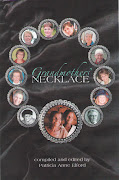
My Writing Group: Life Writers Ink
In the May/June issue of The Word Weaver - the newsletter for The Writers' Circle of Durham Region - is an article on page 3 by Mary McIntyre about our writing group, Life Writer's Ink. Please have a look.
The Road: To Milo
I struggled with the idea of writing something to read at Milo’s funeral. I had never been able to speak at a funeral, even my father’s. I always feared tears would overwhelm me and erase anything I might be trying to say. My husband’s urgings just served to make me more anxious. “I can’t write under pressure! I’m not a Hallmark writer. I work to an inner rhythm”.
I wanted to write something for her, for my step-daughter, my daughter, whom I came to love and admire after over 40 years. The step-daughter who was 5 years older than my first child and forced me to parent her before I was ready. When she hit puberty and needed guidance, I was still dealing with my son’s childhood issues, baseball, summer camp, and public school. Scrambling, I did buy her first bra, bought books explaining the ‘facts of life’ and tried to offer what help I could since she lived with her mother in Toronto and only spent alternate weekends and some holidays with us.
Over the five days in Edmonton I worked on a poem using random notes I had written on the plane. I didn’t know where I was going with it but I knew I wanted it to be a tribute to her strengths. By the night before the funeral, I wasn’t happy with the ending and felt unsure about reading it. Then I realized that was symbolic for all that had happened. I wasn’t happy with her life ending prematurely either. So I read it as is. Perhaps I will tweak it further. Perhaps not.
To Milo
Milo, named for an actress you never knew,
You trekked your bumpy way
Into our lives, our hearts.
Resilient, smiling, resolute,
You navigated two worlds,
Careful never to misstep
The line between country and city.
From school to school, then college.
On to parenthood before we knew it.
Dark years left behind
Out shadowed by baby light,
Travel, another child,
The petite daughter to complete your family,
Submerged in happy domesticity.
More years of turmoil:
You made choices to survive,
Protect your chicks,
Rise above sorrow, grief,
Your mother’s passing.
Seven years in South Dakota brightened life,
College beckoned.
Happiness broke through in snatches.
Back to Alberta, familiar ground
Where you lost and found love.
All the while a mother,
The finest of mothers.
We grieve now with your children,
Almost grown.
Raised and ready
To catch that cold north wind,
Change it into honeyed breezes.
With thoughts of you:
Whispering, directing,
Guiding, giggling,
Quizzing, questioning,
Always loving.
We grieve with the love that appeared,
The one who slipped in,
Grabbed you unawares,
Not knowing you had so little time.
We grieve as parents,
Our daughter lost,
Not meant to outlive our children.
Copyright © 2010, Ruth Zaryski Jackson
I wanted to write something for her, for my step-daughter, my daughter, whom I came to love and admire after over 40 years. The step-daughter who was 5 years older than my first child and forced me to parent her before I was ready. When she hit puberty and needed guidance, I was still dealing with my son’s childhood issues, baseball, summer camp, and public school. Scrambling, I did buy her first bra, bought books explaining the ‘facts of life’ and tried to offer what help I could since she lived with her mother in Toronto and only spent alternate weekends and some holidays with us.
Over the five days in Edmonton I worked on a poem using random notes I had written on the plane. I didn’t know where I was going with it but I knew I wanted it to be a tribute to her strengths. By the night before the funeral, I wasn’t happy with the ending and felt unsure about reading it. Then I realized that was symbolic for all that had happened. I wasn’t happy with her life ending prematurely either. So I read it as is. Perhaps I will tweak it further. Perhaps not.
To Milo
Milo, named for an actress you never knew,
You trekked your bumpy way
Into our lives, our hearts.
Resilient, smiling, resolute,
You navigated two worlds,
Careful never to misstep
The line between country and city.
From school to school, then college.
On to parenthood before we knew it.
Dark years left behind
Out shadowed by baby light,
Travel, another child,
The petite daughter to complete your family,
Submerged in happy domesticity.
More years of turmoil:
You made choices to survive,
Protect your chicks,
Rise above sorrow, grief,
Your mother’s passing.
Seven years in South Dakota brightened life,
College beckoned.
Happiness broke through in snatches.
Back to Alberta, familiar ground
Where you lost and found love.
All the while a mother,
The finest of mothers.
We grieve now with your children,
Almost grown.
Raised and ready
To catch that cold north wind,
Change it into honeyed breezes.
With thoughts of you:
Whispering, directing,
Guiding, giggling,
Quizzing, questioning,
Always loving.
We grieve with the love that appeared,
The one who slipped in,
Grabbed you unawares,
Not knowing you had so little time.
We grieve as parents,
Our daughter lost,
Not meant to outlive our children.
Copyright © 2010, Ruth Zaryski Jackson
The Scent of Lilacs
I was meeting a friend for lunch at the Royal Botanical Gardens in Hamilton on May 6th, 2010 when my husband called to tell me Milo had died. I kept saying “who?” “who died?”. The facts just wouldn’t sink in. “Not Milo!” In a daze I wandered into the foyer to find Marilyn who hadn’t arrived yet. I kept pacing back and forth from one end to the other looking for her. She finally appeared. I waited until we sat down to lunch before blurting out the news. She cried while I robotically repeated the words. We ordered and talked then she asked me if I wanted to go back home. “No,” I said. “I want to see the lilacs. Let’s walk.”
The Lilac Festival was the following weekend and the bushes were in their glory. Purples, mauves, pinks and whites of all species. The flowers never smelled so fragrant to me or looked so glorious. I savoured every inhalation and every vista. We walked slowly and I took many photographs. I thought of Milo and how she would never have this chance again. I thought about how fragile life is and how lucky I was to be able to experience the scent of lilac for another season. We walked and talked. I’m glad I took that time. After a few hours I was ready to drive home, call the airline and fly to Edmonton to face reality.
Losing a Daughter
Losing a daughter is like losing a piece of yourself, a part of your heart or your soul. This is true even when she was your step-daughter.
During the past weeks our family has been rocked by the sudden death of our daughter, Milo Jackson, at the age of 43. She had not been ill but suffered a fatal pulmonary embollism in her sleep on May 6, 2010. She was there in the evening and gone by morning. Twenty days later it seems like a bad dream. I still hope to wake up and find it was a mistake. It didn't really happen. But it did.
I met Milo when she was two years old, a smiling happy toddler. She spent every other weekend with us and holidays too. She was an active part of our family activities, rituals and celebrations. In this favourite photograph of her at about age four or five, she's holding her rabbit which we kept at the farm, and sitting at the piano. She loved playing the piano with Nonie, my husband's mother, whenever we were together.
While I was in Edmonton for the funeral I wrote a poem for Milo which I read during the service. I will be publishing it here as I write about this experience over the next few weeks. Thanks for being there and listening.
Anne Michaels Reads From THE WINTER VAULT
Anne Michaels steps to the microphone and I am enchanted by her mass of dark curly hair. Her voice draws me in with the weightiness and scope of her subject matter. This is no ordinary author reading. She’s not talking about a simple plotline and a quick read. This is a book to be savoured slowly and tenderly with each well-chosen word. The sensual images draw the reader in and bathe you in a dreamy cloud of emotion that lingers long after the book is closed.
I feel badly that I haven’t yet finished THE WINTER VAULT, but I find many others at the reading who also haven’t finished it. It’s a slow read, one that raises many emotional, moral and philosophical questions. It takes time to digest, to ruminate and figure out where we stand. The author tackles these tough issues head-on, but with intimate gentle language that engages the reader.
THE WINTER VAULT is a personal story, a love story, set in a larger historical context in three different settings, Ontario, Egypt and Poland. The historical contexts are the building of the St. Lawrence Seaway in the 1950s, the building of the Aswan Dam in the 1960s and the rebuilding of Warsaw after the Second World War.
The moral and philosophical questions she raises are enormous: science vs. emotion, engineering vs. culture and humanity, the personal history of many vs. the legacy of an important person, authentic vs. recreated landscapes, replicas of cultural heritage vs. sites of heritage significance left ‘in situ’, true memory vs. rewritten tourist ‘history’, progress vs. stagnation, home vs. transience. And more.
I feel a personal connection to her questions from my work as a Historical Planner with the Ministry of Transportation in the 1980s-90s. The ‘mitigation’ solution for heritage resources never felt ‘right’ to me though it was the engineering solution to inconveniently located archaeological, natural or built heritage sites. Many years earlier in 1964, a visiting anthropology professor I met at a party invited me to come to Egypt and join a physical anthropology project. As the Nubian people were being displaced from their home for the building of the Aswan Dam, anthropologists were seizing the opportunity to take physical measurements of them. I felt squeamish and never went. Last year I wrote a poem about it.
Aswan: A Road Not Taken
The theme of The Winter Vault
reminds me of a night.
Was it ’64? maybe ’65.
A house party on Davenport.
Along the curve
towards Avenue Road.
Anthropologists.
Drinking too much.
Hopping over rooftops
Across the abyss, not noticing.
Some visiting professor
tries to persuade me to
come to Egypt.
The Aswan Dam is coming.
Nubians being relocated
-displaced actually-
A chance to measure
skulls and bodies.
For science.
No ethics approval required.
I apologize, stuttering something about
Grad school in the fall.
And wonder these years later:
what if I’d gone?
Copyright © 2010, Ruth Zaryski Jackson
I feel badly that I haven’t yet finished THE WINTER VAULT, but I find many others at the reading who also haven’t finished it. It’s a slow read, one that raises many emotional, moral and philosophical questions. It takes time to digest, to ruminate and figure out where we stand. The author tackles these tough issues head-on, but with intimate gentle language that engages the reader.
THE WINTER VAULT is a personal story, a love story, set in a larger historical context in three different settings, Ontario, Egypt and Poland. The historical contexts are the building of the St. Lawrence Seaway in the 1950s, the building of the Aswan Dam in the 1960s and the rebuilding of Warsaw after the Second World War.
The moral and philosophical questions she raises are enormous: science vs. emotion, engineering vs. culture and humanity, the personal history of many vs. the legacy of an important person, authentic vs. recreated landscapes, replicas of cultural heritage vs. sites of heritage significance left ‘in situ’, true memory vs. rewritten tourist ‘history’, progress vs. stagnation, home vs. transience. And more.
I feel a personal connection to her questions from my work as a Historical Planner with the Ministry of Transportation in the 1980s-90s. The ‘mitigation’ solution for heritage resources never felt ‘right’ to me though it was the engineering solution to inconveniently located archaeological, natural or built heritage sites. Many years earlier in 1964, a visiting anthropology professor I met at a party invited me to come to Egypt and join a physical anthropology project. As the Nubian people were being displaced from their home for the building of the Aswan Dam, anthropologists were seizing the opportunity to take physical measurements of them. I felt squeamish and never went. Last year I wrote a poem about it.
Aswan: A Road Not Taken
The theme of The Winter Vault
reminds me of a night.
Was it ’64? maybe ’65.
A house party on Davenport.
Along the curve
towards Avenue Road.
Anthropologists.
Drinking too much.
Hopping over rooftops
Across the abyss, not noticing.
Some visiting professor
tries to persuade me to
come to Egypt.
The Aswan Dam is coming.
Nubians being relocated
-displaced actually-
A chance to measure
skulls and bodies.
For science.
No ethics approval required.
I apologize, stuttering something about
Grad school in the fall.
And wonder these years later:
what if I’d gone?
Copyright © 2010, Ruth Zaryski Jackson
Moving From Memoir to Novel: Jane Boruszewski's Story ESCAPE FROM RUSSIA
“Your father was lucky to be living now in Canada, and you are lucky too” Janina wrote in one of her comments to me in a writing workshop. She knew all about luck: both the bad luck of being born in Poland in 1926, and the good luck of being a survivor. She was 13 when Stalin’s cruel regime deported her family and over a million and a half Poles from their homes to northern Kazakhstan, Siberia. On the way or during the first winters, many died of starvation including her father, an aunt, her sister, Helcia and a baby brother. She managed to survive the harsh life until the amnesty in 1942 when she left by train with her family to find the Polish Army. When she and her brother and sister contracted typhoid fever they were hospitalized in Bukhara (Uzbekistan) and were separated from the family. Again she survived, and was helped by the Polish Army to escape from Russia through the Caspian Sea to Persia (Iran) and ultimately to a Polish community in Tengeru, Tanganyika (now Tanzania), East Africa where she spent seven years completing high school. After the war ended, she signed up to work at a textile mill in England, where she met her future husband Walter, and later immigrated to America.
I’ve never forgotten Janina because she woke me up to the power of personal story telling to convey larger stories of human history. Janina or Jane Boruszewski was one of several aspiring writers who signed up for an on-line advanced memoir writing workshop with Allyson Latta in the fall of 2008. Jane was writing her memoir, in English, her second language. She had taken other courses and was fluent enough in English to begin writing her stories, seven of which were published in Oasis Journal. Compelled by a need to tell her life story, she continued writing until her death in August 2009, at the age of 82.
Jane’s personality was shaped by her extraordinary experiences. Her writing is important because it gives a human scale to the horrors and suffering of deportation and a life that most of us can’t imagine and have never experienced. She engages the reader by focusing on universal themes of family, love, hate, sickness and death. Then she slows down the narrative so that we can visualize a young couple in the glade in the taiga, and adds just enough context, that the dangers of their encounter are apparent. Too much context would lose the reader. Jane shows the reader what the characters are like with a skillful use of powerful verbs, subtle mention of small gestures or body language and terse bits of dialogue.
After Jane’s death, her husband, Walter Boruszewski, worked with Leila Joiner, editor of Oasis Journal and publisher of Imago Press and Pennywyse Press, to publish a novel based on Jane’s memoirs called ESCAPE FROM RUSSIA. The book is available from Amazon, and Barnes and Noble. Don’t miss it.
Copyright © 2010, Ruth Zaryski Jackson
I’ve never forgotten Janina because she woke me up to the power of personal story telling to convey larger stories of human history. Janina or Jane Boruszewski was one of several aspiring writers who signed up for an on-line advanced memoir writing workshop with Allyson Latta in the fall of 2008. Jane was writing her memoir, in English, her second language. She had taken other courses and was fluent enough in English to begin writing her stories, seven of which were published in Oasis Journal. Compelled by a need to tell her life story, she continued writing until her death in August 2009, at the age of 82.
Jane’s personality was shaped by her extraordinary experiences. Her writing is important because it gives a human scale to the horrors and suffering of deportation and a life that most of us can’t imagine and have never experienced. She engages the reader by focusing on universal themes of family, love, hate, sickness and death. Then she slows down the narrative so that we can visualize a young couple in the glade in the taiga, and adds just enough context, that the dangers of their encounter are apparent. Too much context would lose the reader. Jane shows the reader what the characters are like with a skillful use of powerful verbs, subtle mention of small gestures or body language and terse bits of dialogue.
After Jane’s death, her husband, Walter Boruszewski, worked with Leila Joiner, editor of Oasis Journal and publisher of Imago Press and Pennywyse Press, to publish a novel based on Jane’s memoirs called ESCAPE FROM RUSSIA. The book is available from Amazon, and Barnes and Noble. Don’t miss it.
Copyright © 2010, Ruth Zaryski Jackson
Even More on Family Secrets
After writing these posts I have been asked: “What sorts of things can become a family secret?” The short answer is: anything someone doesn’t want to talk about openly. Certainly there are always private concerns about your family you don’t share with your neighbours or friends. I’m not talking about this type of privacy: something that’s no one's business. But these are not secrets within the family. Everyone knows that old Uncle Harry is like that, whatever “that” is.
I’m talking about secrets that are hidden from others in the family because someone felt shame and thought it best not to talk openly about it. These secrets are then perpetuated down the generations.
What is considered a secret can vary by family, by culture, by ethnicity and by time. These secrets may be health issues e.g. epilepsy or mental retardation which wasn’t widely understood or accepted in the 19th and early 20th century. Or they could be some form of mental illness like schizophrenia or a bi-polar disorder which also wasn’t understood or accepted. Having a sick family member was perceived as a stain on the family and kept hidden.
Other secrets might be accidents or a death of a child if the circumstances were dodgy and the family felt guilty or responsible. Suicides were rarely mentioned but a trail to the truth can be found when Catholics or Greek Catholics were not buried in their own churchyards. Dementia wasn’t accepted by some families. Stories of family addictions, violence, abandonment, sexual abuse or incest were also rarely passed down or, if so, told in a way that diluted or denied any wrongdoing. Illegitimate children, adoption or raising someone else’s child might be kept hidden. Sexual philandering or divorce might be a secret. True sexual orientation might be denied and never discussed.
Sometimes certain hardships e.g. immigration and poverty were considered noble and some families talked about overcoming their humble beginnings. Other immigrants denied their roots and ethnicities, changing or Anglicizing their names when they moved to cities or needed a job.
Family proclivities for thievery or other illegal activities might become a family secret. Jail records or time unaccounted for may have been glossed over in the family story. A successful family might deny the origins of their financial gains during prohibition.
I heard of another kind of family secret when descendants of a family were trying to figure out their genealogy and family connections to a grandfather who had left a wife who didn't want to emigrate and his children in Europe. The man lived with another woman in Canada and raised a second family. Such a tangled web for his descendants to unravel.
After writing this post, I found a comprehensive piece by Dr. Allan Schwartz which explores Family Secrets. John Bradshaw has also written a book called: FAMILY SECRETS: THE PATH TO SELF-ACCEPTANCE AND REUNION.
I’m sure there are many more kinds of family secrets. Do you have any to add?
I’m talking about secrets that are hidden from others in the family because someone felt shame and thought it best not to talk openly about it. These secrets are then perpetuated down the generations.
What is considered a secret can vary by family, by culture, by ethnicity and by time. These secrets may be health issues e.g. epilepsy or mental retardation which wasn’t widely understood or accepted in the 19th and early 20th century. Or they could be some form of mental illness like schizophrenia or a bi-polar disorder which also wasn’t understood or accepted. Having a sick family member was perceived as a stain on the family and kept hidden.
Other secrets might be accidents or a death of a child if the circumstances were dodgy and the family felt guilty or responsible. Suicides were rarely mentioned but a trail to the truth can be found when Catholics or Greek Catholics were not buried in their own churchyards. Dementia wasn’t accepted by some families. Stories of family addictions, violence, abandonment, sexual abuse or incest were also rarely passed down or, if so, told in a way that diluted or denied any wrongdoing. Illegitimate children, adoption or raising someone else’s child might be kept hidden. Sexual philandering or divorce might be a secret. True sexual orientation might be denied and never discussed.
Sometimes certain hardships e.g. immigration and poverty were considered noble and some families talked about overcoming their humble beginnings. Other immigrants denied their roots and ethnicities, changing or Anglicizing their names when they moved to cities or needed a job.
Family proclivities for thievery or other illegal activities might become a family secret. Jail records or time unaccounted for may have been glossed over in the family story. A successful family might deny the origins of their financial gains during prohibition.
I heard of another kind of family secret when descendants of a family were trying to figure out their genealogy and family connections to a grandfather who had left a wife who didn't want to emigrate and his children in Europe. The man lived with another woman in Canada and raised a second family. Such a tangled web for his descendants to unravel.
After writing this post, I found a comprehensive piece by Dr. Allan Schwartz which explores Family Secrets. John Bradshaw has also written a book called: FAMILY SECRETS: THE PATH TO SELF-ACCEPTANCE AND REUNION.
I’m sure there are many more kinds of family secrets. Do you have any to add?
Subscribe to:
Posts (Atom)