The Saga of a Blocked Blogger by Sandy Naiman


Sandy Naiman
age 4 years

Sandy Naiman
Photo by: Mary McIntyre
 Many years ago from the time I was about 11, I babysat for a family across the street from us. Last name: Naiman. Oldest daughter: Sandy Naiman, well-known Toronto journalist at The Sun for 30 years, featured blogger at The Star for 2 years, and currently blogging for PsychCentral. Sandy is a mental health advocate and blogs openly of her journey and struggles for balance in her life. I recontacted her a year ago and asked her to be a guest speaker at a WCDR breakfast sometime. Here is her blogpost about her experience on February 12, 2011:


Copyright © 2011, Ruth Zaryski Jackson

West End Dumplings: Elmwood’s Riverview Hotel (Part 4): The life and d...

Here is the reposting of Christian Cassidy's final chapter on the death of my maternal Great-Aunt Lena Huckan in a fire at the Riverview Hotel 1918.

West End Dumplings: Elmwood’s Riverview Hotel (Part 4): The life and d...: "Elmwood’s Riverview Hotel series: Part 1: Winnipeg gains a suburb Part 2: A controversial place Part 3: A 'near holocaust' Part 4: The life ..."

Copyright © 2011, Ruth Zaryski Jackson

West End Dumplings: Elmwood’s Riverview Hotel (Part 3): A 'near holoc...

Here is Christian's post on the fire at the Riverview Hotel February 5, 1918:

West End Dumplings: Elmwood’s Riverview Hotel (Part 3): A 'near holoc...: "Talbot Ave fire brigade ca. 1921 (source) Though the Elmwood fire hall was within view of the Riverview's front door, at around 3:30 a.m...."

Copyright © 2011, Ruth Zaryski Jackson

My Obsession With My Great-Aunt Lena


Lena Huckan Winnipeg c. 1914

My obsession with my great-aunt Lena has been contagious. Christian Cassidy, a local historian and Winnipeg blogger, has picked up the family story of my great-aunt Lena's death in a hotel fire in Winnipeg on February 5, 1918. He has written a four part piece on the anniversary of the fire and posted his research, with newly discovered photographs from the Manitoba Archives, on one of his captivating blogs called West End Dumplings. I am very grateful to him for uncovering this additional information and publishing her sad story to a wider audience. Thank you Christian!


Copyright © 2011, Ruth Zaryski Jackson

New Blog Link: Skilling Family Memories

I have a new blog listed on the sidebar called SKILLING FAMILY MEMORIES in which I am blogging chapter by chapter my mother-in-law, Norma Skilling Jackson's book about her family history from Scotland to Ontario. I will be adding photographs later. Please check it out.

Copyright © 2010, Ruth Zaryski Jackson

Tracing Lena Huckan – Part One (Ben Nevis House) Guest Post by Christian Cassidy (This Was Winnipeg)

After writing my "Letters to a Dead Great-Aunt" series, I made the acquaintance of Christian Cassidy, a local Winnipeg historian who writes several blogs. He offered to do some additional research for me in Winnipeg to uncover more about the life and death of my Great-Aunt Michalena in a hotel fire in 1918. Here in his guest post is Part One, based on information found in the 1915 Henderson Directory for Winnipeg. Lena was listed as living in Ben Nevis House at 42 Dagmar Street.


Tracing Lena Huckan

Ben Nevis House

In 1903 advertisements begin to appear for "rooms for rent" at 42 Dagmar. At first it was three, then four rooms.


The Morning Telegram -- July 19, 1907

The name "Ben Nevis House" (named for the highest mountain in Great Britain) does not appear in ads until June 1907.


An advertisement in 1917 says that Ben Nevis House is the "first house from Notre Dame". If that is the case then this is a picture of Lena‟s neighbourhood circa 1903. It's a photo looking up Notre Dame FROM Dagmar so that would be her streetcar, taking her to and from the city core.

Could Lena have worked at Ben Nevis as well as live there, similar to what she did (later) at the Riverview (Hotel)? Ben Nevis House routinely had ads similar to this in the papers. From March 14, 1913:

Classified (Manitoba Free Press)
SMART GIRL WANTED AT ONCE FOR
upstairs and wait table. $20. Ben Nevis House. 42 Dagmar Street.

Ben Nevis House was a regular advertiser and not just with little classified ads but larger ones in amongst city hotels; so it may have been a little high end, perhaps out of Lena's price range.
Other mentions of Ben Nevis around the time she may have been living there:


The Voice -- August 3, 1917

Perhaps had some fun while she lived there….

Caledonian Sports Witnessed by Large Crowd at Horse Show Building Last Night. October 5, 1910 MB Free Press
Close on 3,000 people witnessed the first annual Caledonian games at the Horse Show amphitheatre last night. Mixed in with the Scotch music and dancing were the more common athletic sport.
Tug- of war - Caledonians swept everything before them in this contest. They first defeated the Electrical Union team in two straight -pulls and then did the same thing, only more easily, to a team
from the Ben Nevis house.


The Neighbourhood

All of the houses on that first block of Dagmar, and parallel streets, are now gone. That stretch of Notre Dame is fairly commercial with some light industrial and as the Notre Dame buildings expanded, the houses directly behind them disappeared.


Period House near Bannatyne Ave. and Notre Dame http://www.flickr.com/photos/christiansphotos/5138797512/

There are still pockets of period houses in the neighborhood.


These are photos of houses within a couple of blocks of Ben Nevis House and, presumably, would be similar in size or style. Dagmar wasn't noted for being a remarkable street in comparison to the rest of the neighbourhood.

Central Park


Given where she lived, she definitely would have visited Central Park, just a couple of blocks to the south. ( http://winnipegdowntownplaces.blogspot.com/2010/09/downtown-places-central-park.html )

Central Park was one of Winnipeg's first parks. It was originally a natural space, but
by the time she lived there, the park would have boasted tennis courts, a bandshell and the Waddell Fountain. It was a very popular place and you can see the treeline from where she lived.


Some of the old houses and buildings exist around the park. Knox Church (above) was built between 1914 and 1918 (the war interrupted). The Warwick, Winnipeg's first upscale apartment block, was there in 1909. (for more on the Warwick:  http://winnipegdowntownplaces.blogspot.com)


One feature that was unveiled in 1914 was the Waddell Fountain. It was an attraction unto itself. This summer, in fact, the fountain was re-installed after a complete rebuild and upgrade.

More on the fountain and the interesting story behind it http://www.gov.mb.ca/chc/hrb/prov/p078.html)

Other period shots of Central Park: 
http://peel.library.ualberta.ca/postcards/PC002133.html


Copyright © 2010, Christian Cassidy for Ruth Zaryski Jackson


Building the Alaska Highway: Dad's Story

Last Thursday on Remembrance Day I planned to write about my Dad’s contribution to the war effort, building the Alaska Highway. My parents, married in October 1939 just weeks after WW11 broke out, were living and working in Toronto. By 1940 in Canada conscription had been introduced for home defence and Dad was worried. After witnessing WW1 as a child in Europe, he had no appetite for active service.


In 1941, months after I was born, my father took a job with Curran and Briggs, a paving and construction company with the first Canadian contract to work on the construction of the Alaska Highway. My father made that decision without consulting my mother, so she was very angry he was going off for a year, leaving her with a newborn baby and a rooming house to manage in downtown Toronto. From his point of view, it was an opportunity to work at his trade as a welder and earn a lot of money. After finishing a welding course at night school, he’d found it difficult to obtain work in his trade in the 1930s and continued to work in the restaurant business out of necessity. He first heard about the job from a friend, Fred Caruk, who owned Master Welding in Port Credit, just west of Toronto. When Dad was offered a chance to work as welder maintaining all machinery and equipment for this paving company, he saw it as a great chance and a bit of an adventure. It also gave him a way of contributing to the war effort.


Jack Zaryski Pulling Welding Machine for
Curran & Briggs
c. 1942

An Alaska Highway had been proposed and debated in the 1930s, but it wasn’t until fear of a Japanese invasion via Siberia and the Japanese bombing of Pearl Harbour in 1941, that such a road, as a supply route, was thought to be essential for the defence of North America. On February 11, 1942 President Roosevelt officially authorized work to begin by the United States Army Engineer Troops.

According to family lore, my father was already in Alaska by September 1941. He travelled by train from Union Station in Toronto to Edmonton and from there to Dawson Creek, BC. Over the year he would travel with his firm as they advanced construction from Dawson Creek to the highway's middle point. Others were working from Fairbanks, east to the middle point at around Watson Lake.
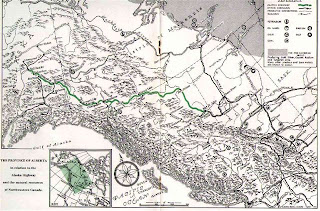

Route of Alaska Highway
Govt. of Alberta
   Working and living conditions were extremely difficult with temperatures ranging from 90 degrees F. to -70 degrees F. Swamps, rivers, ice, cold, mosquitoes, flies and gnats tested the men daily. Most camps were kept open and machinery operated on a 22 hour basis, with 11 hour shifts. Trying to maintain equipment not designed for such conditions, was an ongoing challenge to the creativity of men like my father.


Jack Zaryski
aka. Johnny the Welder
 

While Dad was in Alaska, Mom would tell me stories about him and read his letters to me. After about a year my dad came home for a two month visit when I was about 18 months old. I have no recollection of his visit in October 1942, only the family story that I cried and clung to him in Union Station when he boarded the train to return.


The highway officially opened November 1942, though improvements continued to be made for months and years later. Dad worked in Alaska for another 4 months before coming home for good in about February 1943, just before I turned two years old.


Alaska Highway
Dawson Creek, B.C.
c. 1940s
 I have no memory of his return or the events that followed. The story is that he returned with $30,000 and invested it in a business partnership that went sour. The money vanished and Mom continued for another seven years to run the rooming house and save her meager dollars for a down payment on her dream house in the suburbs. Ashamed of his bad judgement and grateful for Mom's forgiveness, my father started his own welding business, Ontario Collision and Welding. He persevered and was successful.


Copyright © 2010, Ruth Zaryski Jackson